


Contents
- 1 PRP Hair Restoration Therapy – A Solution to Support Hair Loss and Baldness Improvement
- 1.1 Introduction
- 1.2 What Is PRP Hair Restoration Therapy?
- 1.3 How Does PRP Work for Hair Follicles?
- 1.4 Key Benefits of PRP for Hair Restoration
- 1.5 Standard PRP Hair Restoration Procedure
- 1.6 How Long Does It Take to See Results from PRP Hair Therapy?
- 1.7 Why Choose PRP Hair Restoration at Oceania Spa & Clinic Ba Son?
- 1.8 Who Is a Suitable Candidate for PRP Hair Restoration?
- 1.9 Who Should Carefully Consider PRP Before Treatment?
- 1.10 How Much Does PRP Hair Restoration Cost?
- 1.11 Frequently Asked Questions (FAQ)
- 1.11.1 Is PRP Hair Restoration Painful?
- 1.11.2 Can PRP Really Help Hair Regrowth?
- 1.11.3 Does PRP Work for Long-Term Baldness?
- 1.11.4 When Does New Hair Start Growing After PRP?
- 1.11.5 How Many PRP Sessions Are Needed?
- 1.11.6 Is Downtime Required After PRP Hair Treatment?
- 1.11.7 Can PRP Be Combined with Hair Growth Medications?
- 1.12 Call to Action
PRP Hair Restoration Therapy – A Solution to Support Hair Loss and Baldness Improvement
Introduction
Persistent hair loss, thinning hair, widening part lines, or visible scalp exposure around the hairline and crown can significantly affect confidence. Beyond aesthetic concerns, hair loss may be associated with hormonal changes, stress, genetics, improper scalp care, or weakened hair follicles.
PRP Hair Restoration Therapy is a treatment widely used in dermatology and aesthetic medicine to support follicle recovery using the body’s own platelet-rich plasma. PRP is a minimally invasive, non-surgical procedure often considered for individuals with thinning hair, localized hair loss, or androgenetic hair loss while hair follicles are still active.
Recent studies suggest that PRP has the potential to improve hair density and reduce hair shedding. However, results may vary depending on the underlying cause of hair loss, individual biology, and the treatment protocol used.
What Is PRP Hair Restoration Therapy?
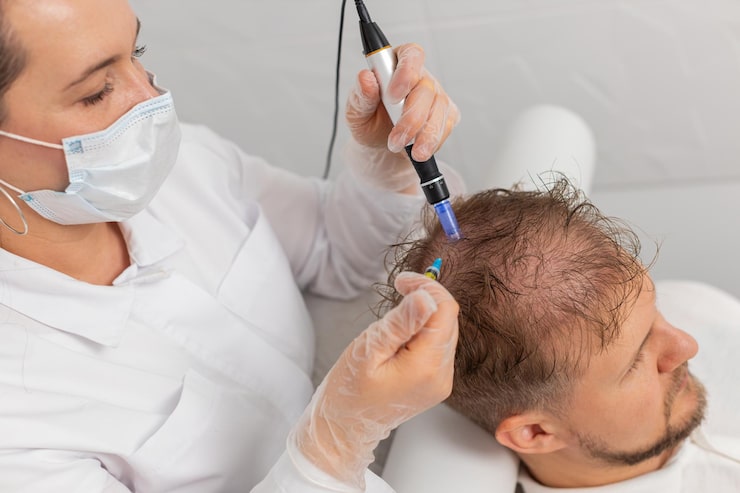
PRP stands for Platelet-Rich Plasma. It is a concentrated portion of plasma obtained from a patient’s own blood through a centrifugation process, resulting in a platelet concentration higher than normal blood levels.
When injected into areas of the scalp affected by hair thinning or hair loss, PRP may help release growth factors that support follicle activity, improve the scalp environment, and promote healthier hair growth.
How Does PRP Work for Hair Follicles?
Growth factors contained within platelets may help:
- Reactivate weakened hair follicles
- Increase blood circulation in the scalp
- Improve oxygen and nutrient delivery to hair roots
- Extend the hair growth (anagen) phase
- Support the growth of thicker, stronger hair while reducing hair shedding
PRP is generally considered an autologous, minimally invasive therapy that can be combined with other hair loss treatments when clinically appropriate.
According to Johns Hopkins Medicine, PRP may be used as a supportive treatment for androgenetic alopecia (male and female pattern hair loss), helping reduce hair loss and encourage new hair growth.
Key Benefits of PRP for Hair Restoration
Uses Your Own Blood for High Biocompatibility
PRP is derived from the patient’s own blood, helping minimize the risk of biological incompatibility.
Minimally Invasive and Non-Surgical
The procedure does not require surgery, incisions, or hair transplantation, making it suitable for individuals seeking a less invasive option.
Supports Hair Loss Reduction
PRP may help improve the scalp environment and support healthier follicle function, which can contribute to reduced hair shedding over time.
Improves Hair Thickness and Density
For follicles that remain active, PRP may help produce thicker, stronger hair and improve overall hair density.
Suitable for Early Hair Thinning and Hair Loss
Outcomes are generally more favorable when treatment is initiated before follicles become permanently inactive.
May Support Post-Hair Transplant Recovery
PRP is sometimes used as an adjunct treatment following hair transplantation to support scalp healing and follicle adaptation.
Standard PRP Hair Restoration Procedure
At reputable dermatology and aesthetic clinics, PRP hair restoration should be performed under sterile conditions with appropriate medical evaluation.
Step 1: Scalp Assessment and Hair Loss Evaluation
A physician or qualified practitioner evaluates:
- Areas of hair thinning
- Severity of hair loss
- Scalp condition
- Medical history
- Hormonal factors
- Stress levels
- Nutritional status
- Current medications
Not all forms of hair loss are suitable candidates for PRP, making this assessment essential.
Step 2: Blood Collection
A small amount of blood is drawn, similar to a routine blood test. The blood is then prepared for centrifugation using a specialized PRP kit.
Step 3: Centrifugation and PRP Separation
The blood is processed in a centrifuge to isolate platelet-rich plasma. PRP quality depends on the extraction protocol, equipment used, and sterility standards.
Step 4: Scalp Numbing
The treatment area is cleansed and numbed to improve patient comfort during the procedure.
Step 5: PRP Injection into Target Areas
Using fine needles, PRP is injected into areas experiencing hair thinning or hair loss, including the part line, temples, frontal hairline, or crown.
Step 6: Post-Treatment Care Instructions
Patients receive guidance regarding:
- Scalp care
- Hair washing schedule
- Medication considerations
- Hair care products
- Follow-up appointments
How Long Does It Take to See Results from PRP Hair Therapy?
PRP does not typically produce immediate results. Hair follicles require time to recover and enter a new growth cycle.
A typical treatment plan may include:
- 3–6 initial treatment sessions
- Sessions spaced approximately 4–6 weeks apart
- Maintenance treatments every 3–6 months depending on individual needs
Some professional recommendations suggest completing at least 3–5 sessions approximately one month apart for androgenetic hair loss.
Noticeable improvements are often evaluated after 3–6 months, when baby hairs begin to appear, shedding decreases, and hair density improves.
Results vary based on:
- Hair loss cause
- Age
- Hormonal factors
- Follicle condition
- Post-treatment care
Why Choose PRP Hair Restoration at Oceania Spa & Clinic Ba Son?
Successful PRP treatment depends not only on injection technique but also on accurate diagnosis, sterile protocols, and personalized treatment planning.
At Oceania Spa & Clinic Ba Son, treatment is guided by professional standards that prioritize safety, suitability, and realistic outcomes.
Personalized Hair Restoration Plans
Hair loss may result from hormones, stress, postpartum changes, nutritional deficiencies, genetics, or improper scalp care. Oceania emphasizes individualized assessment before recommending treatment.
Safety-Focused Treatment Process
Because PRP involves blood collection, processing, and scalp injections, strict hygiene and sterile standards are essential throughout the procedure.
Honest and Realistic Consultation
PRP is a supportive regenerative therapy, not an instant cure for hair loss. Oceania provides transparent information regarding expected timelines, treatment goals, and individual response.
Combination Treatment Options
Depending on the case, PRP may be combined with scalp care programs, topical treatments, lifestyle modifications, or other supportive therapies to optimize results.
Who Is a Suitable Candidate for PRP Hair Restoration?
PRP may be suitable for:
- Individuals experiencing ongoing hair loss
- Thinning or weakened hair
- Early-stage male or female pattern hair loss
- Widening part lines
- Early thinning at the hairline or crown
- Individuals seeking improved hair density without hair transplantation
- Patients requiring support after hair transplant procedures
- Individuals with active hair follicles and no severe scalp infection
Who Should Carefully Consider PRP Before Treatment?
Although PRP uses autologous blood and is considered minimally invasive, medical evaluation is still necessary.
Inform your physician if you:
- Take anticoagulant or blood-thinning medications
- Have platelet disorders or clotting disorders
- Have scalp infections or severe inflammatory scalp conditions
- Have cancer, bloodstream infections, or uncontrolled chronic diseases
- Are pregnant or breastfeeding
- Smoke heavily or abuse alcohol or recreational substances
- Are taking medications that require medical review
For hair loss caused by hormonal disorders, anemia, nutritional deficiencies, or scalp diseases, addressing the underlying condition may be necessary alongside PRP treatment.
How Much Does PRP Hair Restoration Cost?
In Vietnam, PRP hair treatment typically ranges from approximately 4,000,000 to 10,000,000 VND per session, depending on:
- Clinic standards
- PRP centrifugation technology
- PRP kit quality
- Severity of hair loss
- Treatment protocol
However, treatment decisions should not be based solely on price.
Important considerations include:
- Clinic reputation
- Sterility standards
- PRP extraction quality
- Practitioner qualifications
- Availability of consultation and follow-up care
- Clear communication regarding expected outcomes
An in-person consultation is recommended to determine the most appropriate treatment plan and cost.
Frequently Asked Questions (FAQ)
Is PRP Hair Restoration Painful?
The scalp is typically numbed before treatment. Most patients experience only mild discomfort or slight stinging during injections.
Can PRP Really Help Hair Regrowth?
PRP may support follicle activity and improve hair density in certain individuals, particularly when follicles remain viable. Results vary and should be evaluated over the course of treatment.
Does PRP Work for Long-Term Baldness?
If follicles have been permanently lost for many years, PRP may provide limited benefit. A medical evaluation is necessary to determine whether active follicles remain.
When Does New Hair Start Growing After PRP?
Hair shedding may begin to decrease within weeks to months. New hair growth and visible density improvements often require approximately 3–6 months.
How Many PRP Sessions Are Needed?
Most treatment plans include 3–6 sessions spaced 4–6 weeks apart, followed by maintenance sessions as recommended.
Is Downtime Required After PRP Hair Treatment?
PRP is minimally invasive and generally requires little to no downtime. Patients should follow post-treatment instructions and avoid excessive scalp manipulation or harsh chemical treatments initially.
Can PRP Be Combined with Hair Growth Medications?
In some cases, PRP may be combined with physician-recommended hair growth medications or topical therapies. Self-medication is not advised without professional guidance.
Call to Action
The longer hair loss persists, the greater the risk that hair follicles may weaken and become less responsive to treatment. If you are experiencing excessive hair shedding, thinning hair, receding hairlines, crown thinning, or widening part lines, early evaluation is recommended.
At Oceania Spa & Clinic Ba Son, personalized PRP Hair Restoration consultations help determine the underlying cause of hair loss and identify the most appropriate treatment plan based on your individual condition.
Contact Oceania Spa & Clinic Ba Son today to schedule a scalp assessment and receive a customized PRP hair restoration consultation.