


Contents
- 1 Introduction
- 2 Overview of the 3-Month Melasma Treatment Journey at Oceania Ba Son
- 3 Month 1: Skin Barrier Repair and Pigmentation Control
- 4 Month 2: Laser Pico and ND:YAG for Pigmentation Targeting
- 5 Month 3: Multi-Layer Regeneration and Maintenance
- 6 Real Client-Style Stories
- 7 Why Is Oceania Ba Son Highly Rated for Melasma Treatment?
- 8 What to Know Before Laser Melasma Treatment
- 9 FAQ
- 10 CTA: Book a Melasma Consultation at Oceania Ba Son
Introduction
Melasma is not just a few brown patches on the skin. For many people, it affects confidence, makeup habits, and the way they feel when looking in the mirror.
This is especially true for those with patchy melasma, deep dermal pigmentation, mixed melasma, or weakened skin caused by unknown cosmetic products or harsh bleaching creams. In these cases, treatment usually requires more than one laser session. The skin needs to be restored, pigmentation must be controlled, and treatment should be carried out in stages.
At Oceania Spa & Clinic Ba Son, the 3-month melasma treatment journey is designed around a personalized protocol, combining Laser Pico, Laser ND:YAG, and skin-repair serums to help improve uneven pigmentation in a controlled and science-based way.
Note: Melasma treatment results vary depending on melasma type, skin condition, lifestyle, sun protection habits, and home skincare compliance. This article presents a realistic treatment journey and should not be understood as a guaranteed result for every client.
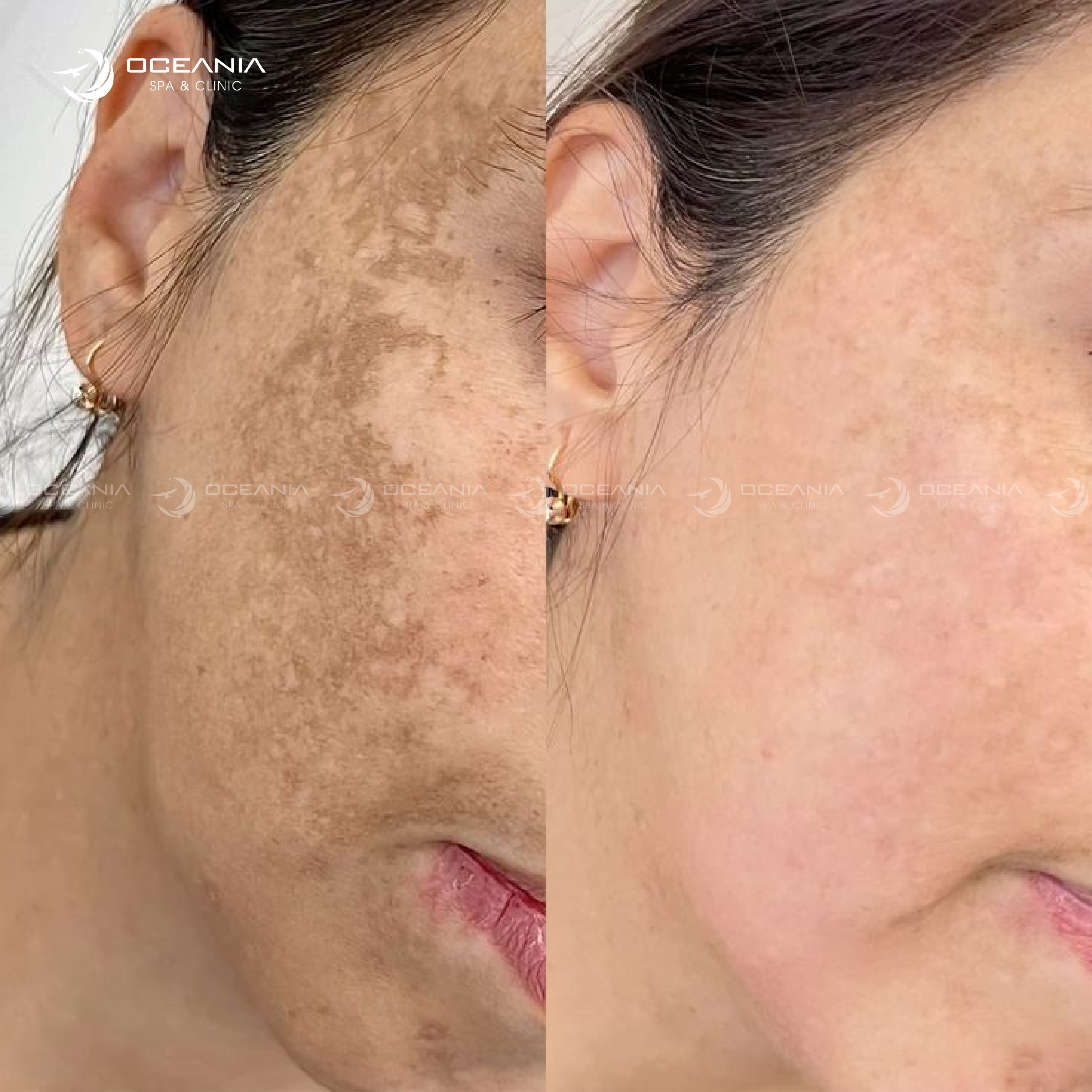
Overview of the 3-Month Melasma Treatment Journey at Oceania Ba Son
An effective melasma protocol should not focus only on making brown patches fade quickly. If the skin barrier is weak, the skin is inflamed, or melanin production remains active, melasma may return or become darker after treatment.
That is why a 3-month journey at Oceania usually focuses on three main goals:
- Repairing the skin barrier before intensive treatment
- Controlling excessive pigmentation
- Applying laser technology at the right stage
- Supporting skin regeneration and maintenance
- Guiding aftercare to help reduce the risk of recurrence
Month 1: Skin Barrier Repair and Pigmentation Control
Initial skin condition
The client came to Oceania with:
- Melasma patches on both cheeks
- Dull and uneven skin tone
- Sensitive and easily irritated areas
- Dry and dehydrated skin surface
- History of using unknown or harsh cosmetic products
- Thin and weakened skin barrier
With this type of skin, aggressive laser treatment from the first session may not always be the best choice. The first priority is to stabilize the skin.
Treatment focus in the first month
The doctor at Oceania assessed the skin condition and designed a recovery-first protocol. The initial stage may include:
- Soothing the skin
- Deep hydration
- Supporting skin barrier repair
- Using suitable micro-infusion serums
- Helping regulate pigmentation activity
- Simplifying the home skincare routine
- Strict daily sun protection
In some cases, brightening and recovery serums such as Pink Glow may be considered as part of the treatment plan, depending on the skin condition and doctor’s indication.
Visible changes after Month 1
After the first stage, clients may not see dramatic fading of melasma immediately. Instead, the most important improvements are often seen in the overall skin foundation:
- Better hydration
- Softer skin texture
- Reduced sensitivity
- Surface dullness may appear lighter
- Skin becomes more stable for laser treatment
This stage is important because healthier skin responds better to pigmentation treatment.
Month 2: Laser Pico and ND:YAG for Pigmentation Targeting
Treatment goal
In the second month, once the skin barrier is more stable, the doctor may start or intensify laser-based treatment.
The goal of this stage is to:
- Target melanin pigments
- Help fade darker pigmentation areas
- Improve uneven skin tone
- Minimize damage to surrounding skin
- Combine laser with recovery support to reduce irritation risk
Laser Pico and 1064nm Nd:YAG are commonly used in pigmentation and melasma protocols. However, the treatment must be performed carefully because melasma-prone skin may react with post-inflammatory hyperpigmentation if not managed properly.
What the laser session feels like
During treatment, clients may experience:
- Skin cleansing
- Eye protection
- Marking or checking pigmented areas
- Energy setting adjustment
- Laser treatment
- Soothing and calming aftercare
- Homecare instructions
The sensation may include mild warmth, tingling, or slight snapping depending on the device, energy level, and individual tolerance.
Visible changes after Month 2
After several properly planned treatment sessions, clients may notice:
- Some surface pigmentation appears lighter
- Skin tone looks brighter
- Darker patches become less contrasted
- Pores may appear more refined in some areas
- Skin looks clearer and fresher
However, this is also the stage where aftercare is extremely important. Without proper sun protection, barrier repair, and skincare discipline, pigmentation can darken again.
Month 3: Multi-Layer Regeneration and Maintenance
Treatment goal
The third month is not just the “final month” of treatment. It is the stage where results are consolidated and maintained.
At Oceania, the doctor may combine:
- Intensive recovery serums
- LED or bio-light therapy
- Brightening-support ingredients
- Hydrating and calming care
- Inflammation control
- Home routine adjustment
Visible changes after 3 months
After 3 months of following the protocol, many clients may notice more visible improvements:
- More even skin tone
- Reduced intensity of melasma patches
- Lighter surface pigmentation
- More radiant and healthier-looking skin
- Stronger and less dehydrated skin barrier
- Greater confidence with minimal makeup
For deep dermal melasma or long-standing mixed melasma, a longer treatment and maintenance phase may be needed. The doctor will reassess the skin before deciding whether to continue laser, focus on recovery, or adjust the homecare plan.
Real Client-Style Stories
Case 1: Patchy melasma and weakened skin after harsh products
Client N.M from Ho Chi Minh City had previously tried several quick-whitening methods. Her skin became thin, easily flushed, and the melasma patches on both cheeks became more visible.
When she came to Oceania, the doctor did not recommend aggressive laser treatment immediately. Instead, the first stage focused on barrier repair. Laser and skin-repair serums were introduced gradually afterward.
After 3 months, the melasma patches became visibly lighter, the overall skin tone looked more even, and the skin appeared healthier. What the client appreciated most was not only the pigmentation improvement, but also the feeling that her skin was stronger and less dependent on heavy concealer.
Case 2: Long-standing deep pigmentation
Client T.A had deep pigmented spots that had been present for years and did not respond well to regular skincare products.
For this case, Oceania recommended a longer-term treatment direction using Laser Pico, ND:YAG, and recovery support. After 3 months, the pigmentation showed positive improvement, darker spots appeared less visible, and the overall complexion looked brighter.
The key message from the doctor was clear: deep melasma requires patience, and clients should not expect complete clearance after only one or two sessions.
Why Is Oceania Ba Son Highly Rated for Melasma Treatment?
1. Personalized by melasma type
Not all pigmentation conditions are the same. Patchy melasma, deep melasma, mixed melasma, freckles, and age spots require different approaches.
At Oceania, the doctor evaluates the skin before recommending a treatment plan.
2. Combination of technology and recovery
Laser can help target pigmentation, but without skin recovery, the skin may become sensitive and pigmentation may return. Oceania focuses on both:
- Pigmentation treatment
- Skin barrier restoration
3. No quick-whitening approach
Quick whitening methods may make the skin thinner, more sensitive, and more prone to pigmentation recurrence. Oceania focuses on gradual and controlled improvement with skin health as the priority.
4. Convenient location in District 1
Oceania Ba Son is located in the Vinhomes Golden River area, convenient for clients in District 1, Binh Thanh, Thu Thiem, Thao Dien, and central Ho Chi Minh City.
5. Suitable for local and international clients
Oceania offers a professional medical aesthetics experience, private treatment space, and clear consultation support, making it suitable for Vietnamese clients, overseas Vietnamese, and expatriates living in Ho Chi Minh City.
What to Know Before Laser Melasma Treatment
Laser treatment for melasma is not a “one-and-done” solution. To achieve better improvement and reduce recurrence risk, clients should understand that:
- Melasma is linked to sunlight, hormones, genetics, and skin barrier health
- Long-standing melasma often needs more time
- Strict sun protection is essential after treatment
- Strong acids, retinol, or peeling products should not be used without guidance
- Unknown whitening creams, harsh peeling products, and mixed creams should be avoided
- Follow-up visits are important for protocol adjustment
FAQ
Can melasma completely disappear after 3 months?
It is not appropriate to guarantee complete clearance for every case. Mild to moderate patchy melasma may improve visibly within 3 months. Deep, mixed, or long-standing melasma may require a longer treatment journey.
Can Pico Laser treat deep melasma?
Pico Laser may help improve certain types of deeper pigmentation. However, results depend on melasma type, pigment depth, skin response, and practitioner expertise.
Is ND:YAG safe for melasma?
1064nm ND:YAG is commonly used in pigmentation treatments. However, energy settings and technique must be carefully selected to reduce the risk of irritation or post-inflammatory hyperpigmentation.
Can melasma come back after treatment?
Yes. Melasma can recur due to sun exposure, hormonal changes, stress, or unsuitable skincare. Maintenance and sun protection are essential.
Is Oceania Ba Son suitable for weakened skin?
Weakened skin should be assessed by a doctor first. In many cases, Oceania prioritizes skin barrier repair before intensive laser treatment.
How long does it take to see improvement?
Some clients may notice brighter skin after a few sessions, but visible pigmentation improvement usually takes time and consistency. Results vary depending on melasma type and aftercare compliance.
CTA: Book a Melasma Consultation at Oceania Ba Son
If you have tried many melasma treatments but your pigmentation remains visible, becomes darker, or your skin feels weaker, it may be time for a more personalized and medically guided approach.
Oceania Spa & Clinic Ba Son helps clients identify the type of pigmentation, build a personalized treatment journey, and monitor skin changes through each stage.
You can book a consultation to:
- Analyze your skin and melasma type
- Receive a personalized treatment recommendation
- Learn about Laser Pico, ND:YAG, and skin-repair serums
- Get aftercare guidance
- Estimate treatment duration and cost based on your actual condition
Oceania Spa & Clinic Ba Son – Personalized melasma treatment focused on skin recovery and scientific pigmentation improvement.