


Contents
- 1
- 2 What Treatments Can Improve Acne Scars?
- 3 Why Is Identifying the Scar Type So Important?
- 4 Fractional CO2 Laser: Resurfacing and Collagen Remodeling
- 5 RF Microneedling: Stimulating Collagen with Needles and Radiofrequency
- 6 Subcision: Releasing Fibrous Bands Beneath Acne Scars
- 7 Can Multiple Acne Scar Treatments Be Combined?
- 8 How Do Physicians Choose the Right Acne Scar Treatment?
- 9 Acne Scar Treatment at Oceania
- 10 Why International Patients Choose Oceania
- 11 Can Acne Scars Be Completely Removed?
- 12 Conclusion
- 13 FAQ
- 13.0.1 What is the best treatment for acne scars?
- 13.0.2 Can CO2 Laser treat all types of acne scars?
- 13.0.3 Can RF Microneedling improve acne scars?
- 13.0.4 Can CO2 Laser and RF Microneedling be combined?
- 13.0.5 Should active inflammatory acne be treated before acne scars?
- 13.0.6 Can international patients receive acne scar treatment at Oceania?
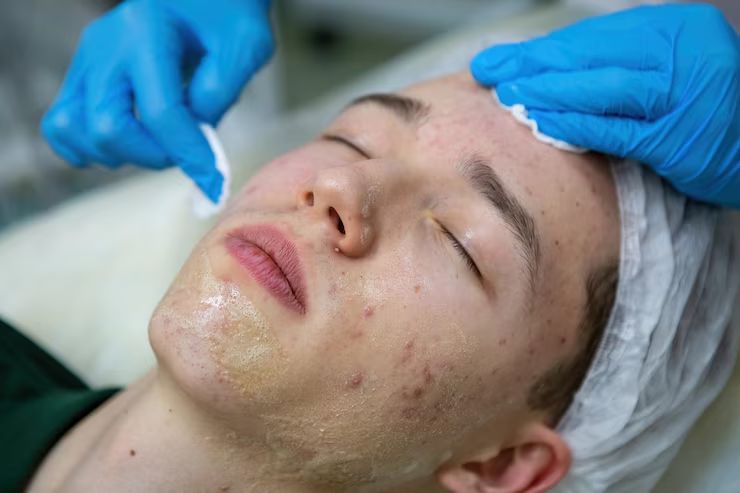
What Treatments Can Improve Acne Scars?
Acne scars are among the more challenging skin concerns to treat.
Unlike post-acne pigmentation, which primarily involves changes in skin color, atrophic acne scars involve structural changes in the skin, including damage to collagen and underlying supporting tissue.
This is why conventional creams and serums alone often cannot significantly correct depressed scars.
Today, physicians can choose from several technologies and techniques designed to stimulate collagen, remodel scar tissue and improve overall skin texture.
Common approaches include:
- Fractional CO2 Laser.
- RF Microneedling.
- Subcision for selected scars.
- Collagen-stimulating treatments.
- Multimodal combination protocols.
The most important principle is that there is no single acne scar treatment that works best for every scar type.
Why Is Identifying the Scar Type So Important?
One common mistake is seeing an “acne scar” and immediately choosing a laser treatment.
In reality, acne scars have different shapes and underlying mechanisms.
Ice Pick Scars
Ice pick scars are typically narrow but relatively deep depressions that extend into the skin.
They may require specialized techniques or combination treatment rather than surface resurfacing alone.
Boxcar Scars
Boxcar scars are more defined depressions with wider, often sharper edges.
Depending on their depth and characteristics, physicians may consider collagen-remodeling treatments such as Fractional CO2 Laser or RF Microneedling.
Rolling Scars
Rolling scars create an undulating or wave-like appearance.
In some cases, fibrous bands underneath the skin may pull the surface downward. When this occurs, collagen stimulation alone may not fully address the underlying structural problem.
A physician may consider subcision or a combination approach when clinically appropriate.
Fractional CO2 Laser: Resurfacing and Collagen Remodeling
Fractional CO2 Laser is widely used as part of acne scar treatment plans.
The laser creates controlled microscopic treatment zones within the skin.
This process can support:
- Skin regeneration.
- Collagen remodeling.
- Improved texture.
- Reduction in the appearance of selected depressed scars.
- Improvement in enlarged pores and surface signs of aging.
CO2 Laser can be particularly useful when patients have a combination of acne scars, uneven texture and visible pores.
However, because it can produce relatively strong resurfacing effects, treatment parameters should be carefully selected according to the patient’s skin type and condition.
RF Microneedling: Stimulating Collagen with Needles and Radiofrequency
RF Microneedling combines microneedling with Radiofrequency energy.
Small needles create controlled microscopic treatment points while RF energy delivers thermal stimulation to targeted tissue.
This approach may support:
- Collagen production.
- Skin firmness.
- Improved texture.
- Reduced appearance of enlarged pores.
- Improvement of selected acne scars.
One advantage of RF Microneedling is that energy can be delivered into targeted tissue without necessarily resurfacing the entire skin surface as aggressively as some ablative resurfacing procedures.
Subcision: Releasing Fibrous Bands Beneath Acne Scars
For certain rolling scars, depressed areas may be associated with fibrous bands pulling the skin downward.
Subcision is a technique that uses a specialized needle to release these tethering bands.
When appropriately indicated, subcision may be combined with collagen-stimulating treatments to further improve scar appearance.
Because this is an invasive medical technique, it should be performed by an appropriately trained medical professional rather than at an unqualified beauty facility.
Can Multiple Acne Scar Treatments Be Combined?
In many cases, yes.
Acne scarring often involves more than one mechanism.
A patient may have:
- Ice pick scars.
- Boxcar scars.
- Rolling scars.
- Enlarged pores.
- Uneven texture.
- Post-inflammatory pigmentation.
Using one technology for the entire face may therefore not always provide the most comprehensive approach.
A physician may develop a multimodal acne scar treatment plan, with each technology targeting a different aspect of the condition.
For example:
Subcision → release tethered scar tissue
Fractional CO2 → skin resurfacing
RF Microneedling → collagen stimulation and structural remodeling
However, not every patient requires all of these treatments.
How Do Physicians Choose the Right Acne Scar Treatment?
1. Scar Type
Ice pick, boxcar and rolling scars require different approaches.
2. Scar Depth
Superficial and deep scars should not automatically receive the same treatment intensity.
3. Current Skin Condition
If active inflammatory acne is still present, the physician may prioritize acne control first before performing more intensive scar-remodeling procedures.
4. Skin Type and Pigmentation Risk
Patients who are prone to post-inflammatory hyperpigmentation may require carefully selected treatment parameters.
5. Recovery Time
This is particularly important for international patients living or working in Vietnam.
Patients should inform their physician about:
- Business trips.
- Travel plans.
- Important events.
- International flights.
This allows the treatment plan to be coordinated with the patient’s schedule and desired recovery time.
Acne Scar Treatment at Oceania
At Oceania, acne scar treatment is not based on a one-size-fits-all protocol.
A physician directly evaluates:
- Scar morphology.
- Scar depth.
- Fibrotic tethering.
- Skin texture.
- Pore size.
- Active acne.
- Pigmentation.
- Skin sensitivity.
- Previous treatments.
The appropriate technology and treatment parameters are selected only after this assessment.
A personalized plan may include
- Fractional CO2 Laser.
- RF Microneedling.
- Subcision.
- Collagen-stimulating treatments.
- Combination technologies across different treatment stages.
The goal is not simply to treat as aggressively as possible, but to address the underlying scar mechanism while maintaining appropriate control over the skin’s recovery process.
Why International Patients Choose Oceania
Direct Physician Assessment
This is especially important when patients are considering energy-based treatments or invasive scar-remodeling techniques.
Personalized Treatment Plans
Not every patient needs CO2 Laser.
Not every patient is suitable for RF Microneedling.
The physician selects the treatment according to the actual condition of the skin.
Professional Technology and Equipment
Oceania prioritizes professional equipment with identifiable origins, with device information and serial numbers managed according to the clinic’s procedures. Certain devices may meet international standards such as FDA or CE, depending on the specific device.
Medical-Standard Treatment Process
Oceania emphasizes:
- Pre-treatment assessment.
- Hygiene and infection-control procedures.
- Skin preparation.
- Post-treatment monitoring.
- Detailed home-care instructions.
International Patient Support
English-language support helps international patients understand:
- Their scar type.
- Recommended technology.
- Expected number of sessions.
- Recovery time.
- Post-treatment care.
Can Acne Scars Be Completely Removed?
This is one of the most common questions patients ask.
The realistic answer is that not every acne scar can be completely erased after a few treatments.
The goal of treatment is generally to:
- Make scars less noticeable.
- Improve skin texture.
- Create a more even skin surface.
- Stimulate collagen remodeling.
- Improve overall skin quality.
The degree of improvement depends on:
- Scar type.
- Scar depth.
- Scar age.
- Individual healing response.
- Collagen condition.
- Selected treatment.
- Number of sessions.
- Post-treatment care.
For this reason, a staged treatment plan is often more realistic than expecting complete scar removal in a single session.
Conclusion
Modern acne scar treatment is no longer limited to a single technology.
Fractional CO2 Laser, RF Microneedling, Subcision and collagen-stimulating approaches can all play different roles in personalized acne scar treatment plans.
The key is not choosing the “strongest” technology. It is accurately identifying the scar type and selecting the appropriate treatment strategy.
At Oceania, physicians directly assess each patient’s skin and create a personalized plan. Different technologies may be combined across treatment stages when clinically appropriate.
If you are an international patient searching for Acne Scar Treatment Vietnam, Fractional CO2 Laser Vietnam or RF Microneedling Vietnam, start with a professional scar assessment rather than choosing a technology based solely on advertising.
FAQ
What is the best treatment for acne scars?
There is no single best treatment for everyone. Scar type, depth, skin condition and individual goals determine the most appropriate approach.
Can CO2 Laser treat all types of acne scars?
No. CO2 Laser can be useful for many patients, but different scar types may respond differently. Some rolling or ice pick scars may require additional techniques.
Can RF Microneedling improve acne scars?
RF Microneedling may help improve selected acne scars and uneven texture through collagen stimulation and remodeling. A physician should assess the scar type before recommending it.
Can CO2 Laser and RF Microneedling be combined?
They may be combined in selected cases. A physician should determine the appropriate technologies, sequence and treatment intervals to allow adequate skin recovery.
Should active inflammatory acne be treated before acne scars?
In many cases, controlling active inflammatory acne first may be appropriate before beginning intensive scar-remodeling treatments.
Can international patients receive acne scar treatment at Oceania?
Yes. Oceania supports international patients with English-language consultation and personalized treatment plans based on scar type, skin condition, treatment goals and recovery requirements.