


Contents
- 1 How Does Hair Follicle Cycling Work?
- 2 How Can PRP Support Weakened Hair Follicles?
- 3 Is PRP Suitable for Postpartum Hair Loss?
- 4 When Should Postpartum Hair Loss Be Evaluated?
- 5 Does One PRP Treatment Make Hair Grow Immediately?
- 6 How Long Does It Take to See Hair Changes After PRP?
- 7 Can PRP Restore a Completely Lost Hair Follicle?
- 8 PRP Hair Regrowth Therapy at Oceania
- 9 Why Is Medical Assessment Important Before Hair PRP?
- 10 FAQ – PRP for Postpartum Hair Loss
- 10.0.1 Can postpartum hair loss recover naturally?
- 10.0.2 Can PRP help postpartum hair growth?
- 10.0.3 Does PRP make hair grow immediately?
- 10.0.4 Can PRP restore completely lost follicles?
- 10.0.5 Does hair PRP require multiple sessions?
- 10.0.6 Does PRP use the client’s own blood?
- 10.0.7 When can postpartum women have hair PRP?
- 10.0.8 Is PRP suitable for every type of hair loss?
- 11 Postpartum Hair Thinning: Look Beyond the Hair You Shed
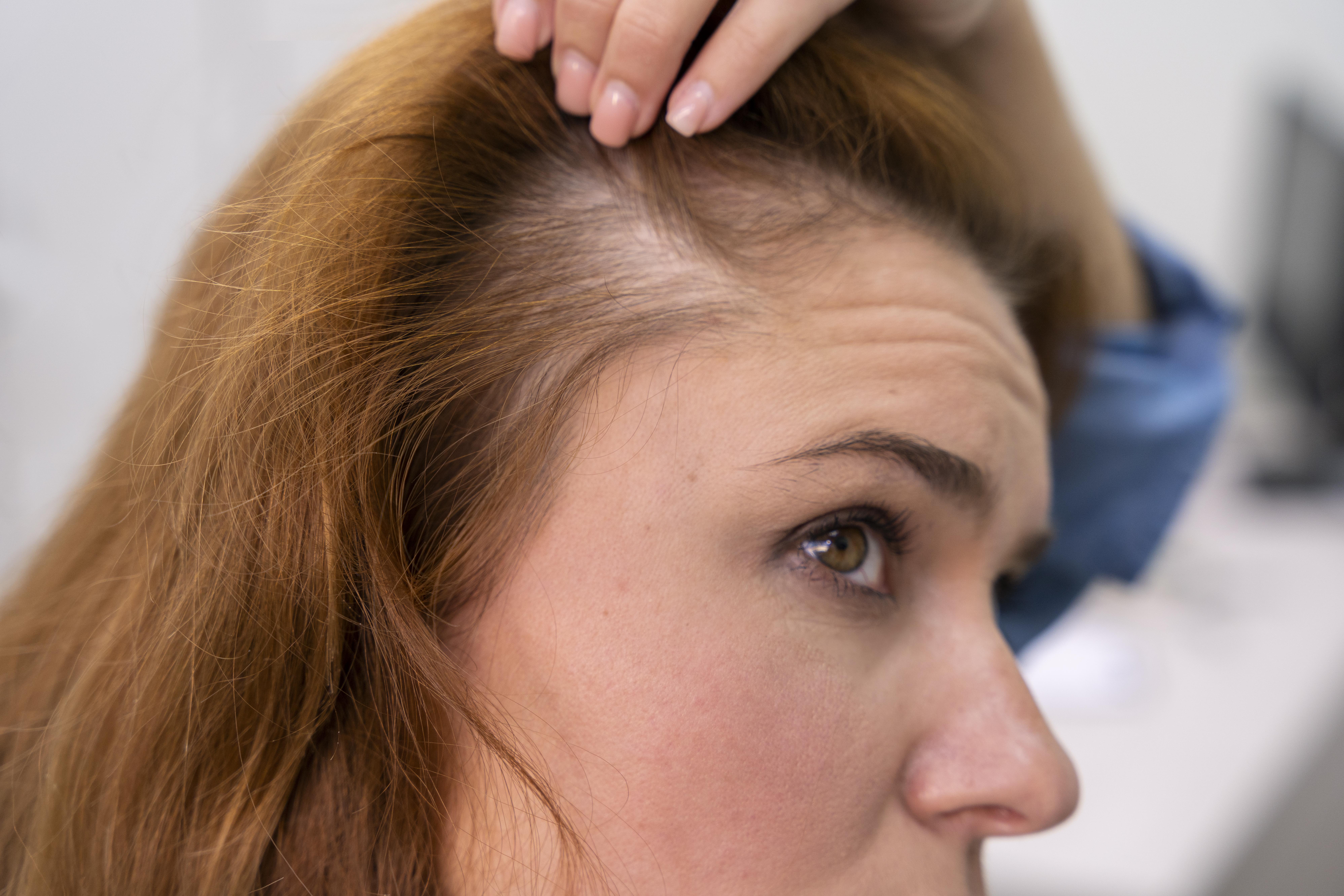
Why Does Hair Loss Increase After Pregnancy?
Many women notice significantly more hair shedding after giving birth.
Hair may:
- Shed heavily during washing.
- Become thinner along the part line.
- Look less dense around the crown.
- Make more of the scalp visible.
- Produce new hair more slowly.
- Feel noticeably less dense overall.
One common explanation is a change in the hair growth cycle after pregnancy.
During pregnancy, hormonal changes may keep more hairs in the growth phase for longer. After delivery, changes in the hormonal environment can cause a larger number of follicles to enter the resting phase at around the same time.
This can result in increased shedding, commonly referred to as postpartum telogen effluvium.
Importantly:
Postpartum hair shedding does not automatically mean permanent baldness.
However, persistent thinning or clearly reduced density should be evaluated.
How Does Hair Follicle Cycling Work?
Each strand of hair grows from a hair follicle within the scalp.
The hair cycle can broadly be divided into:
Anagen – Growth Phase
The follicle is active and the hair shaft continues to grow.
Catagen – Transition Phase
Follicle activity decreases as it enters a transitional stage.
Telogen – Resting Phase
Hair growth pauses and the hair may eventually shed as a new cycle begins.
After childbirth, hormonal changes can cause a larger number of follicles to enter telogen at the same time.
As a result, hair shedding may become much more noticeable.
The goal of hair-growth therapies is not simply to “stop shedding,” but to support the scalp environment and hair follicles so that healthy hair cycling can continue.
How Can PRP Support Weakened Hair Follicles?
PRP stands for Platelet-Rich Plasma.
It is prepared from the client’s own blood and processed to obtain plasma with a higher concentration of platelets, which can then be used on selected areas of the scalp.
Platelets contain various proteins and growth factors involved in tissue repair and cellular signaling.
When PRP is delivered into appropriate areas of the scalp, these biological components may support the environment surrounding hair follicles through several mechanisms studied in hair restoration research.
The general concept is:
PRP
↓
Release of growth factors
↓
Support for cellular signaling around follicles
↓
Support for the local tissue and microvascular environment
↓
Support for weakened follicles
↓
Potential support for the active growth phase
The objective is to create a more supportive environment for existing follicles that remain biologically active.
How Do Growth Factors in PRP Support Hair Follicles?
PRP contains natural growth factors from platelets that may help support the environment around the hair follicles.
Simply put, PRP is designed to support weakened hair follicles, improve the scalp environment, and create more favorable conditions for hair growth.
Rather than focusing only on the visible hair shaft, PRP targets the scalp and hair follicles – where hair growth begins.
PRP is more suitable for follicles that are still present but have become weakened or less active. If a follicle has been completely lost, PRP cannot create a new hair follicle.
Can PRP Help Hair Grow Stronger?
PRP may help support the active growth phase of the hair cycle, giving the follicles a more favorable environment to produce healthier-looking hair.
When the follicles are properly supported, hair may grow more consistently and the progression of thinning may be reduced.
This can be particularly relevant when hair shows signs of:
Weak hair → gradual thinning → reduced hair density → increasingly visible scalp
Therefore, the goal of PRP is not only to reduce hair shedding but also to support hair follicle health and the natural hair growth process.
Results vary depending on the cause of hair loss, the condition of the hair follicles, and each individual’s response to treatment.
Is PRP Suitable for Postpartum Hair Loss?
It may be considered in selected cases, but not every case of postpartum hair loss requires PRP.
Postpartum shedding can have multiple contributing factors, including:
- Hormonal changes.
- Telogen effluvium.
- Nutritional deficiencies.
- Stress and sleep disruption.
- Scalp conditions.
- Genetic hair loss.
- Thyroid or other medical conditions.
Therefore, the first step is to understand what type of hair loss is occurring and whether the follicles remain active.
If the shedding is typical postpartum telogen effluvium and is already improving, observation and evaluation of underlying causes may be appropriate.
If thinning persists or follicular activity appears reduced, PRP may be considered as a supportive treatment.
When Should Postpartum Hair Loss Be Evaluated?
Postpartum shedding can be normal, but evaluation is advisable when:
Hair shedding continues or worsens
The amount of shedding does not appear to be decreasing.
The part line becomes noticeably wider
More scalp becomes visible around the crown.
New hair growth remains limited
Previously dense areas do not appear to recover as expected.
There are localized areas of thinning
Hair loss occurs in clearly defined patches rather than diffuse shedding.
The scalp develops symptoms
Such as persistent itching, redness, scaling, pain or inflammation.
In these situations, identifying the underlying cause is important before choosing a hair-growth treatment.
Does One PRP Treatment Make Hair Grow Immediately?
No.
The hair cycle moves much more slowly than ordinary skin healing.
Even when follicles respond well, hair needs time to progress through its growth cycle.
Therefore, PRP is commonly planned as a series of treatments with periodic assessment, rather than as a single session expected to produce immediate visible regrowth.
The number of sessions, treatment intervals and maintenance plan can be individualized according to:
- Severity of hair loss.
- Hair density.
- Follicular condition.
- Cause of hair loss.
- Response to each treatment.
How Long Does It Take to See Hair Changes After PRP?
Hair does not suddenly become longer immediately after PRP.
The follicle needs time to respond and the hair cycle needs time to progress.
Some clients may notice:
Early stage: changes in the pattern of shedding.
Following stage: improvement in baby hairs or apparent density in follicles that remain active.
Longer-term: continued assessment of hair density and shaft quality.
Individual results vary significantly and depend on the underlying cause of hair loss and the condition of the follicles before treatment.
Can PRP Restore a Completely Lost Hair Follicle?
This should not be expected.
PRP is primarily investigated as a supportive treatment for existing follicles that remain but may be weakened or surrounded by a less favorable tissue environment.
If follicles have been completely lost in an area of the scalp, PRP cannot simply create new follicles.
This is why early assessment can be useful when hair density begins to decline.
PRP Hair Regrowth Therapy at Oceania
At Oceania, PRP hair treatment focuses specifically on the scalp and hair follicles, with medical assessment before treatment.
01. Scalp Assessment
The doctor evaluates areas of thinning, hair density and scalp condition.
02. Identify the Hair-Loss Pattern
The onset, severity and possible contributing factors are reviewed.
03. Autologous Blood Collection
The client’s own blood is collected to prepare the platelet-rich plasma.
04. PRP Preparation
The blood sample is processed to obtain the appropriate plasma fraction for the treatment.
05. Scalp Treatment
PRP is delivered to selected scalp areas according to the individualized treatment plan.
06. Follicle Monitoring
Hair density and scalp response are assessed over time to determine whether the treatment plan should be adjusted.
Why Is Medical Assessment Important Before Hair PRP?
“Hair loss” is not a single diagnosis.
Two people may both have thinning hair while having completely different underlying causes.
For example:
Postpartum shedding
≠
Androgenetic hair loss
≠
Alopecia areata
≠
Scalp disease-related hair loss
Treating only with PRP while ignoring the underlying cause may lead to unrealistic expectations.
At Oceania, the doctor assesses the scalp and hair follicles before developing an individualized treatment plan rather than applying the same protocol to every client.
FAQ – PRP for Postpartum Hair Loss
Can postpartum hair loss recover naturally?
Some postpartum hair shedding can improve as the hair cycle returns toward its normal pattern. Persistent thinning or clearly reduced density should be assessed.
Can PRP help postpartum hair growth?
PRP may be considered to support existing, active hair follicles in selected cases. Results depend on the cause of hair loss and the condition of the follicles.
Does PRP make hair grow immediately?
No. Hair growth follows a biological cycle and requires time. PRP does not produce immediate hair growth after injection.
Can PRP restore completely lost follicles?
No. PRP cannot recreate hair follicles that have been completely lost. Its role is primarily supportive for existing but weakened follicles.
Does hair PRP require multiple sessions?
Treatment is commonly planned as a series of sessions with periodic assessment rather than a single treatment. The number and interval depend on individual hair loss and response.
Does PRP use the client’s own blood?
Yes. PRP is prepared from the client’s own blood and processed to obtain a platelet-rich plasma fraction.
When can postpartum women have hair PRP?
There is no single postpartum timeline that applies to everyone. Medical history, current health, the cause of hair loss and postpartum stage should be considered before treatment. If you are breastfeeding or have an underlying medical condition, discuss suitability directly with your doctor.
Is PRP suitable for every type of hair loss?
No. PRP is not appropriate for every cause of hair loss. Identifying the cause and assessing the follicles are important before treatment.
Postpartum Hair Thinning: Look Beyond the Hair You Shed
Hair density is not determined only by how much hair you see in the shower.
More important questions include:
Are the follicles still active?
What is happening to the hair growth cycle?
Is the scalp healthy?
What is causing the hair loss?
PRP focuses on the scalp and hair follicle environment, using biological components from platelet-rich plasma to support follicular activity in appropriate cases.
If your hair has become noticeably thinner after pregnancy, don’t wait until the scalp becomes significantly visible before having the condition assessed.
Learn More About PRP Hair Regrowth Therapy at Oceania
🌐 Website: https://oceaniaspa.vn/
💇 PRP Hair Regrowth Therapy: https://oceaniaspa.vn/prp-hair-regrowth-therapy/
📍 Oceania Ba Son – Ho Chi Minh City: SH06 – Aqua 3, Vinhomes Golden River, 2 Ton Duc Thang Street, Ho Chi Minh City
📞 Ho Chi Minh Hotline: (+84) 36 637 0508