


Contents
- 1 What Is Skin Purging?
- 2 What Is Cosmetic Irritation or Allergy?
- 3 Purging vs Cosmetic Reaction: Quick Comparison
- 4 1. Look at Where the Breakouts Appear
- 5 2. Look at What the Skin Actually Looks Like
- 6 3. Pay Attention to Stinging and Burning
- 7 4. Watch How Your Skin Changes Over Time
- 8 5. Do Not Judge Purging by Acne Count Alone
- 9 When Should You Stop a Product and Seek Professional Advice?
- 10 Do Not Confuse Purging With “Detoxing”
- 11 When You Are Not Sure, Get Your Skin Assessed
- 12 Why Choose Oceania for Skin Assessment?
- 13 FAQ – Purging vs Cosmetic Reaction
- 14 Purging or Allergy? Understand Your Skin Before You React
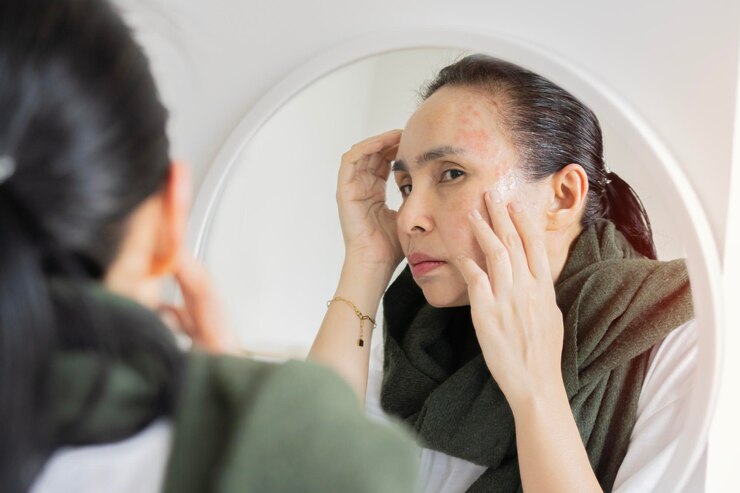
New Breakouts After a New Skincare Product: Purging or Irritation?
You have just started a new skincare product, and a few days later your skin suddenly develops more bumps.
Is it Purging?
Not necessarily.
Skin can react to a new cosmetic product for different reasons. Two commonly confused possibilities are Purging and irritation or an allergic reaction.
The key is not simply counting the number of new spots. Instead, look at:
Where they appear → what they look like → how they feel → how they change over time.
What Is Skin Purging?
Purging generally refers to a temporary increase in acne-like breakouts that may occur when introducing certain skincare products that influence skin cell turnover.
A useful clue is location.
Purging tends to occur in areas that are already prone to clogged pores or breakouts.
For example, if your forehead has always been acne-prone, new breakouts appearing mainly on the forehead after introducing a new active product may be more consistent with purging than a generalized skin reaction.
However, Purging does not automatically mean that a product is suitable for you.
What Is Cosmetic Irritation or Allergy?
Irritation occurs when the skin reacts negatively to a product or ingredient.
An allergic reaction involves an immune response to a substance recognized by the body as an allergen.
Possible signs include:
- Redness.
- Itching.
- Burning or stinging.
- Tightness.
- Small bumps.
- Swelling.
Unlike typical acne, irritation or allergy may affect areas that previously had little or no acne.
If your skin suddenly becomes red, itchy, hot or uncomfortable over a wider area, do not automatically assume it is Purging.
Purging vs Cosmetic Reaction: Quick Comparison
| Feature | Purging | Irritation / Allergy |
| Location | Often acne-prone or congested areas | May affect areas that were previously clear |
| Appearance | More consistent with familiar acne or congestion | May include widespread tiny bumps or redness |
| Sensation | Usually less dominated by intense itching or burning | Itching, stinging or burning may be prominent |
| Redness | May occur but is not usually the main feature | Redness may be obvious |
| Progression | May settle as the skin adapts | May continue or worsen if exposure continues |
| Pattern | Often localized to breakout-prone areas | May spread across areas exposed to the product |
This table is a general guide, not a diagnosis.
1. Look at Where the Breakouts Appear
If the new spots appear mainly where you normally experience clogged pores or acne, Purging may be one possibility.
For example:
Previously acne-prone forehead → new product → more breakouts mainly on the forehead.
That pattern may be more consistent with Purging.
By contrast, if previously clear areas suddenly become red, itchy or irritated after product application, be more cautious.
2. Look at What the Skin Actually Looks Like
Purging tends to resemble the types of acne your skin normally develops.
Irritation or allergy may look different:
Redness → tiny bumps → itching → stinging → burning.
If the reaction does not resemble your usual acne and is accompanied by significant discomfort, do not automatically label it as Purging.
3. Pay Attention to Stinging and Burning
This is one of the easiest clues to overlook.
If you notice a few new pimples without significant itching or burning, the situation may be different from widespread skin irritation.
But if you experience:
- Persistent itching.
- Burning.
- Facial heat.
- Prolonged stinging.
- Significant redness.
you should not simply “push through it” because you believe your skin is purging.
4. Watch How Your Skin Changes Over Time
Time can help reveal the pattern.
If Purging is occurring, it is generally considered a temporary phase associated with the introduction of certain products.
If your skin continues to become increasingly red, itchy, painful or irritated, the possibility of irritation or an allergic reaction becomes more concerning.
There is no universal number of days that can confirm Purging for everyone.
5. Do Not Judge Purging by Acne Count Alone
A common misconception is:
“More acne means the product is purging my skin.”
Not necessarily.
Consider the complete picture:
Location + appearance + sensation + redness + progression.
Example A
Breakouts appear mainly in an area that is normally congested, without significant itching or burning, and the situation remains relatively stable.
→ Purging may be one possibility.
Example B
The skin suddenly becomes red, itchy, hot and covered with small bumps across a wider area.
→ Irritation or an allergic reaction should be considered.
When Should You Stop a Product and Seek Professional Advice?
If you develop significant itching, burning, swelling, spreading redness or worsening irritation, do not continue using the product simply because you believe your skin needs to “get used to it.”
If you experience severe symptoms such as facial or lip swelling, difficulty breathing or signs of a systemic allergic reaction, seek urgent medical care.
For less severe but persistent reactions, consider stopping the suspected new product and having your skin professionally assessed.
Do Not Confuse Purging With “Detoxing”
Some skincare marketing uses phrases such as:
“Detox the skin” – “push toxins out” – “the more acne, the better.”
However, an increase in breakouts does not automatically mean that the skin is “detoxing.”
Skin reactions should be assessed according to their appearance, sensation and progression, rather than assuming that more acne means a product is working.
When You Are Not Sure, Get Your Skin Assessed
You do not have to diagnose the reaction yourself.
A professional assessment can consider:
Your skin before the product → newly introduced products → location → appearance → redness or itching → progression over time.
This can be particularly useful when several skincare products have been introduced at once.
Why Choose Oceania for Skin Assessment?
At Oceania Spa & Clinic, the approach begins with understanding the client’s skin before selecting a treatment. The Ho Chi Minh City clinic emphasizes doctor-led care, personalized recommendations and honest guidance when a treatment is not appropriate.
Doctor-led care
Oceania Ba Son follows a doctor-led treatment model, with procedures performed by doctors rather than technicians.
Personalized recommendations
The clinic considers the individual’s skin condition and treatment goals rather than applying the same approach to everyone.
Genuine technology and international standards
Oceania presents a range of professional aesthetic technologies. Depending on the specific system, equipment may carry international certifications or standards such as FDA, CE, KFDA or ISO. Certification should be checked according to the specific device/model and intended use.
Treatment only when appropriate
Oceania’s philosophy is that not every treatment is right for every person. The goal is to help clients understand their options before deciding what is appropriate for their skin.
FAQ – Purging vs Cosmetic Reaction
Can Purging cause itching?
Purging is generally associated with acne-like breakouts rather than significant itching or burning. Strong itching, burning or widespread redness should raise concern about irritation or an allergic reaction.
Where does Purging usually occur?
Purging tends to occur in areas that are already prone to acne or clogged pores.
Does every breakout after a new skincare product mean Purging?
No. Location, appearance, sensation and progression should all be considered.
Should I continue using a product if my skin is red and itchy?
Do not assume that significant irritation is Purging. If the reaction is persistent or worsening, stop the suspected product and seek professional advice.
When should I see a doctor?
Seek professional assessment if redness, itching, burning or swelling continues or worsens. Severe symptoms such as difficulty breathing require urgent medical attention.
Purging or Allergy? Understand Your Skin Before You React
Not every breakout after a new skincare product is Purging, and not every new bump means an allergy.
Remember these four clues:
📍 Location – 👀 Appearance – 🔥 Sensation – ⏱ Progression
If breakouts appear in your usual acne-prone areas without significant irritation, you may be able to monitor the skin carefully.
But if your skin becomes red, itchy, burning, stinging or increasingly irritated, do not simply call it “Purging.”
At Oceania, clients can begin with a doctor-led skin assessment before deciding whether their skincare routine needs adjustment or whether a professional treatment is appropriate.
Learn more:
🌐 Oceania Spa & Clinic: oceaniaspa.vn
🌐 Oceania: oceania.vn
🌐 Oceania Spa & Clinic – Ho Chi Minh City: clinic-hochiminh.oceaniaspa.vn
📍 Oceania Ba Son: SH06 – Aqua 3, Vinhomes Golden River, 2 Ton Duc Thang Street, Ho Chi Minh City
📞 Ho Chi Minh Hotline: (+84) 36 637 0508
Oceania Spa & Clinic – Doctor-led assessment, personalized recommendations, genuine technology and an approach focused on safe, natural-looking results.