


Contents
- 1 Why Are Long-Standing Acne Scars More Difficult to Improve?
- 2 Signs You May Have Mature Fibrotic Acne Scars
- 3 A Multi-Step Approach for Long-Standing Fibrotic Scars
- 4 Step 2: Fractional CO₂ Laser – Skin Resurfacing
- 5 Step 3: PRP – Supporting the Recovery Process
- 6 Why Isn’t Laser Alone Always Enough for Fibrotic Scars?
- 7 Can Long-Standing Fibrotic Acne Scars Be Completely Removed?
- 8 Who May Benefit From This Approach?
- 9 Why Choose Oceania for Acne Scar Treatment?
- 10 How Long Does It Take to See Improvement?
- 11 FAQ – Long-Standing Fibrotic Acne Scars
- 12 Long-Standing Scars Need the Right Treatment Strategy
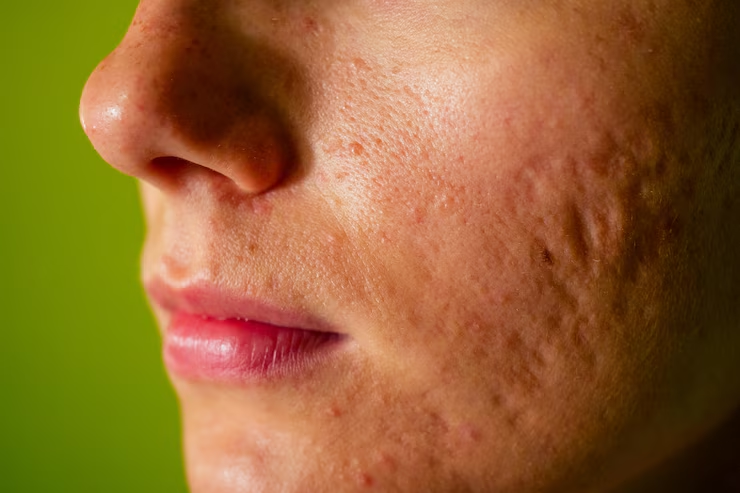
Can Long-Standing Fibrotic Acne Scars Still Be Improved?
Yes, in many cases—but long-standing fibrotic acne scars often require more than one treatment approach.
Some mature acne scars can develop firm fibrous bands beneath the skin. These bands may pull the scar downward and create persistent depressions that remain visible for years.
This is one reason why treating only the skin surface may provide limited improvement.
For long-standing fibrotic acne scars, the treatment strategy may need to address different layers of the scar:
Release the fibrous attachment → resurface the skin → support the recovery process.
At Oceania Spa & Clinic, the treatment plan is based on an assessment of the individual’s scar characteristics rather than applying the same protocol to every client.
Why Are Long-Standing Acne Scars More Difficult to Improve?
Not all acne scars have the same structure.
Over time, some mature scars may develop fibrous tissue beneath the skin.
A simple way to understand the process is:
Skin injury → scar formation → fibrous tissue develops → tissue contracts → the skin surface becomes depressed.
When fibrous bands continue pulling the scar downward, improving only the surface of the skin may not fully address the reason behind the depression.
This is why clients who have had acne scars for many years and experienced limited improvement from surface treatments may benefit from having their scar structure reassessed.
Signs You May Have Mature Fibrotic Acne Scars
Long-standing scars can have several characteristics, including:
- Scars that have remained for many years.
- Persistent depressions that change very little over time.
- Areas that feel firmer or more tethered than the surrounding skin.
- Depressions that become particularly visible under certain lighting.
- Limited improvement after surface-focused treatments.
However, you should not diagnose fibrotic scars based on appearance alone.
A doctor should assess the scar type, depth and degree of tethering before determining the appropriate treatment.
A Multi-Step Approach for Long-Standing Fibrotic Scars
When fibrous attachments are present, doctors may consider combining:
Subcision → Fractional CO₂ Laser → PRP
Each step has a different purpose.
Step 1: Subcision – Releasing the Scar’s Fibrous Attachment
Subcision is a technique used to address fibrous bands that tether certain depressed scars to the underlying tissue.
A suitable needle or instrument is carefully introduced beneath the scar to release the fibrous attachment pulling the scar downward.
The objective is to free the tethered area and create conditions for the depressed skin to improve.
This technique requires careful assessment and appropriate medical technique.
Not every acne scar requires subcision.
The doctor should first determine whether fibrous tethering is actually present.
Step 2: Fractional CO₂ Laser – Skin Resurfacing
Once the underlying scar structure has been addressed, Fractional CO₂ Laser may be incorporated into the treatment plan to improve the skin surface.
The laser creates controlled microscopic treatment zones in the skin, stimulating the skin’s natural regeneration and collagen remodeling processes.
The goal is not to “erase” an acne scar in a single session.
Instead, the objective is to gradually improve skin texture, smoothness and overall surface appearance.
Fractional laser technology is commonly used as part of acne scar treatment plans, with treatment intensity adjusted according to the individual’s skin condition and scar characteristics.
Step 3: PRP – Supporting the Recovery Process
PRP, or platelet-rich plasma, is prepared from the client’s own blood.
After blood collection and processing, the platelet-rich plasma is separated and prepared according to the treatment protocol.
In acne scar treatment, PRP may be incorporated to support the skin’s recovery following procedures.
Importantly, PRP does not replace subcision when a scar has significant fibrous tethering.
The roles can be understood simply as:
Subcision → addresses the tethered scar
Fractional CO₂ Laser → supports skin resurfacing and collagen remodeling
PRP → supports the recovery process
Whether all three are appropriate depends on the individual’s scar condition and should be determined by the treating doctor.
Why Isn’t Laser Alone Always Enough for Fibrotic Scars?
Fractional CO₂ Laser primarily works through controlled skin resurfacing and stimulation of the skin’s regenerative processes.
However, if a depressed scar is still being pulled downward by fibrous tissue, treating only the surface may not fully address the underlying tethering.
This is particularly relevant for mature fibrotic acne scars.
Instead of asking only:
“Which laser should I use?”
A more important question is:
“What is pulling the scar down?”
The doctor may need to evaluate:
- The scar type.
- The depth of the scar.
- Whether fibrous tethering is present.
- The overall skin condition.
- Previous treatments.
- How the skin is likely to respond.
This approach allows the treatment plan to be more personalized.
Can Long-Standing Fibrotic Acne Scars Be Completely Removed?
It is important to set realistic expectations.
No reputable clinic should promise that mature acne scars will be completely erased or disappear 100% after one treatment.
The realistic goals of treatment are to:
- Reduce the depth and visibility of depressed scars.
- Improve the overall skin texture.
- Soften the appearance of mature scar tissue.
- Create a more even-looking skin surface.
- Make scars less noticeable under normal lighting.
The degree of improvement depends on several factors, including scar type, depth, degree of fibrosis, skin condition and individual healing response.
Long-standing scars may require several treatment stages rather than a single session.
Who May Benefit From This Approach?
A combined treatment approach may be considered for clients who have:
- Acne scars that have remained for many years.
- Depressed scars with suspected fibrous tethering.
- Firm or mature scar tissue.
- Limited improvement from surface-only treatments.
- A desire to improve both the underlying scar structure and skin texture.
However, subcision, Fractional CO₂ Laser and PRP should not automatically be performed on everyone.
A medical assessment is important before deciding which techniques are appropriate.
Why Choose Oceania for Acne Scar Treatment?
At Oceania Spa & Clinic, acne scar treatment is approached through individual assessment and personalized treatment planning.
Rather than automatically applying the same technology to every client, the doctor evaluates the characteristics of the scars and selects an appropriate combination of procedures.
Doctor-Led Treatment
Medical aesthetic procedures should be performed by appropriately qualified medical professionals.
Oceania’s Ho Chi Minh City clinic follows a doctor-led treatment model, with doctors directly performing procedures rather than leaving the entire treatment process to technicians.
Professional Technology & International Standards
Oceania uses professional aesthetic technologies and equipment associated with international standards, including FDA and CE certifications where applicable to the specific device and intended use.
For medical aesthetic equipment, the exact certification should always be considered according to the specific device and model rather than the technology name alone.
Personalized Treatment Planning
Acne scars are not one-size-fits-all.
One person may have relatively shallow scars, while another may have deeper, tethered and mature fibrotic scars.
Oceania therefore emphasizes individual assessment and personalized treatment planning rather than automatically recommending the same procedure to every client.
A Safety-Focused Treatment Process
For procedures involving controlled skin intervention, Oceania places emphasis on hygiene, appropriate equipment and professional treatment protocols.
The objective is not only to improve the appearance of acne scars, but also to support a controlled recovery process.
How Long Does It Take to See Improvement?
Acne scar treatment is a gradual process.
Subcision addresses the structural component of a tethered scar, while Fractional CO₂ Laser works through controlled resurfacing and collagen remodeling.
The skin then needs time to recover and remodel.
Therefore, the final result should not be judged immediately after treatment.
Your doctor may assess the skin after each treatment stage and adjust the next session according to your response.
FAQ – Long-Standing Fibrotic Acne Scars
Can acne scars that are several years old still improve?
Yes. Many mature acne scars can be improved, although the degree of improvement depends on the scar type, depth, fibrosis and individual healing response.
Does every fibrotic acne scar require subcision?
No. Subcision is generally considered when fibrous tethering is present. A doctor should assess the scar before deciding whether the technique is appropriate.
Can Fractional CO₂ Laser treat fibrotic acne scars on its own?
Fractional CO₂ Laser can improve skin texture and support collagen remodeling. However, if a scar is strongly tethered by fibrous tissue, surface resurfacing alone may not fully address the underlying problem.
Can PRP replace subcision?
No. PRP does not replace a structural procedure when fibrous tethering requires release. It may instead be incorporated into selected treatment plans to support recovery.
Will one treatment remove old acne scars?
Usually, treatment should be viewed as a progressive process rather than a one-time procedure. The number of sessions depends on the type and severity of the scars and the individual’s response.
Long-Standing Scars Need the Right Treatment Strategy
Mature fibrotic acne scars should not be viewed simply as a surface skin problem.
When a scar has developed fibrous attachments beneath the skin, treating only the surface may not be enough.
A personalized treatment plan may combine:
Subcision – releasing fibrous scar attachments
Fractional CO₂ Laser – skin resurfacing and collagen remodeling
PRP – supporting the skin recovery process
The most important step is still accurate scar assessment before treatment.
At Oceania Spa & Clinic, clients receive a doctor-led assessment and personalized treatment planning based on the characteristics of their acne scars. The clinic also emphasizes professional technologies, appropriate international standards and a controlled treatment process.
Learn More About Acne Scar Treatment at Oceania
Oceania Spa & Clinic: oceaniaspa.vn
Oceania Clinic – Ho Chi Minh City: clinic-hochiminh.oceaniaspa.vn
Book a consultation: Contact Oceania to have your acne scars assessed by a doctor and receive a personalized treatment plan.
Oceania Spa & Clinic – Doctor-led aesthetic care, professional technology, personalized protocols and a safety-focused approach.