


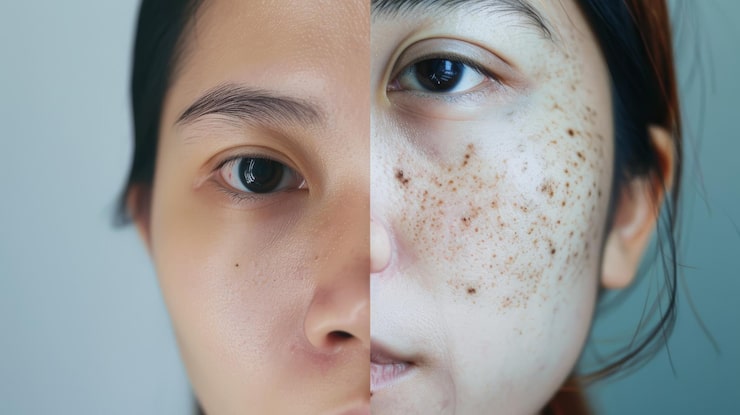
Post-inflammatory hyperpigmentation, commonly known as PIH, and long-term melasma can both cause darkened, brown, grayish, or uneven patches on the skin. Because their external appearance may look quite similar, many people mistake acne marks for melasma or assume hormonal melasma is just ordinary dark spots.
The key issue is: PIH and long-term melasma should not be treated the same way.
PIH usually appears after acne, skin inflammation, scratching, improper peeling, or unsuitable laser treatment. Meanwhile, long-term melasma is often linked to multiple factors such as hormones, genetics, sun exposure, and overactive pigment-producing cells.
If misdiagnosed or treated with the wrong laser wavelength or incorrect energy settings, the skin may become more irritated, increasing the risk of further post-inflammatory pigmentation. That is why the most important step before pigmentation treatment is not to “start laser immediately,” but to correctly identify the type of pigmentation, its depth, and the current condition of the skin barrier.
Contents
- 1 What Is PIH? What Is Long-Term Melasma?
- 2 Comparison Table: PIH vs. Long-Term Melasma
- 3 How to Recognize PIH and Melasma at Home
- 4 Why Can Misdiagnosis Make Pigmentation Worse?
- 5 PIH Treatment Protocol at Oceania Spa & Clinic
- 6 Long-Term Melasma Treatment Protocol at Oceania Spa & Clinic
- 7 Multi-Technology Approach to Prevent Post-Treatment Hyperpigmentation
- 8 Why Choose Oceania Spa & Clinic for Pigmentation Treatment?
- 9 Who Should Have a Pigmentation Consultation Early?
- 10 SEO FAQ About PIH and Long-Term Melasma
- 10.1 Can PIH fade on its own?
- 10.2 Can long-term melasma be completely cured?
- 10.3 Why do acne marks become darker after squeezing pimples?
- 10.4 Should PIH be treated with laser?
- 10.5 Can melasma and PIH appear at the same time?
- 10.6 Can laser treatment for melasma make the skin darker?
- 10.7 Is sunscreen really important in pigmentation treatment?
- 11 CTA: Skin Analysis and Pigmentation Diagnosis at Oceania Spa & Clinic
What Is PIH? What Is Long-Term Melasma?
Post-Inflammatory Hyperpigmentation PIH
PIH — Post-Inflammatory Hyperpigmentation is a condition where the skin becomes darker after inflammation or injury. Common causes include inflammatory acne, improper acne extraction, dermatitis, burns, scratches, aggressive peeling, or unsuitable laser procedures.
PIH can occur in all skin types, but it is often more noticeable and longer-lasting in Asian skin tones or skin that is prone to pigmentation.
Long-Term Melasma
Long-term melasma, often referred to as hormonal melasma, is a chronic pigmentation condition that is prone to recurrence and usually appears in patches. Melasma is commonly associated with sun exposure, hormonal changes, genetics, pregnancy, birth control pills, perimenopause, or menopause.
Unlike PIH, long-term melasma is not only limited to superficial pigmentation. It may involve the epidermis, dermis, vascular factors, and low-grade inflammation within the skin. Therefore, melasma requires long-term control rather than overly aggressive treatment in a short period.
Comparison Table: PIH vs. Long-Term Melasma
| Criteria | Post-Inflammatory Hyperpigmentation PIH | Long-Term Melasma / Hormonal Melasma |
| Main cause | After inflammation or injury: acne, acne picking, scratching, peeling, improper laser treatment | Hormonal factors, genetics, UV rays, visible light, skin aging |
| Location | Exactly where acne, wounds, or irritation previously occurred | Commonly on both cheeks, forehead, chin, and upper lip |
| Appearance | Separate spots, irregular shapes, sometimes associated with acne scars | Wide patches, symmetrical distribution, uneven borders |
| Color | Pink-red, brown, dark brown, or black after inflammation | Light brown, yellow-brown, gray-brown, or deeper grayish pigmentation |
| Pigment depth | Usually more superficial, but can be deeper after severe inflammation | Can be mixed superficial and deep pigmentation, prone to recurrence |
| Improvement potential | Often improves well when inflammation is controlled and sun protection is consistent | Requires persistence and long-term pigment suppression |
| Risk of wrong treatment | May become darker if aggressive laser or peeling is used too early | May spread, darken, or recur quickly if treated improperly |
How to Recognize PIH and Melasma at Home
Signs That Suggest PIH
You may be experiencing post-inflammatory hyperpigmentation if the darkened area:
- Appears after inflammatory acne, cystic acne, or nodular acne.
- Is located exactly where acne was picked or where the skin was scratched.
- Appears as separate spots and is not symmetrical.
- Starts as red or pink, then gradually turns brown.
- Is associated with acne scars, pitted scars, or previous peeling.
- Becomes darker after peeling, laser, or overly strong skincare treatments.
PIH usually requires calming inflammation, repairing the skin barrier, sun protection, and melanin control. Treatment often begins with controlling the inflammatory cause, strengthening the skin, and using suitable brightening ingredients.
Signs That Suggest Long-Term Melasma
You may be experiencing long-term melasma if the pigmentation:
- Appears as symmetrical patches on both cheeks.
- Spreads across the cheekbones, forehead, chin, or upper lip.
- Has no previous acne lesion or injury at the same location.
- Becomes darker after sun exposure, stress, or hormonal changes.
- Recurs despite using many brightening products.
- Appears brown-gray, yellow-brown, or patchy and seems deeper under the skin.
Melasma is more challenging to treat because it is highly recurrent and usually requires a combined protocol including sun protection, pigment-suppressing ingredients, suitable peels or laser, and long-term maintenance.
Why Can Misdiagnosis Make Pigmentation Worse?
Skin affected by PIH or melasma has one thing in common: pigment cells are more reactive than usual. When the wrong method is used, especially aggressive peeling, high-energy laser, or treatment while the skin is still inflamed, the skin may respond by producing even more melanin.
A common mistake is assuming that every brown spot should be treated with laser immediately. In reality, not every type of pigmentation should begin with laser. For fresh PIH after acne, if the skin is still inflamed, red, or barrier-damaged, aggressive treatment may make the dark marks worse.
For long-term melasma, if the treatment only focuses on breaking down pigmentation without controlling triggers such as sunlight, hormones, low-grade inflammation, and long-term skincare, melasma can easily return.
PIH Treatment Protocol at Oceania Spa & Clinic
For post-inflammatory hyperpigmentation, the goal is not to “attack the dark spots aggressively,” but to reduce inflammation, restore the skin, control melanin, and brighten safely.
At Oceania Spa & Clinic, clients receive skin analysis, skin barrier assessment, and pigmentation classification before a treatment plan is designed. For PIH, the protocol often prioritizes methods that cause minimal thermal damage and are suitable for sensitive skin after acne or previous interventions.
1. Multi-Layer Skin Recovery With Mesotherapy
Mesotherapy can be personalized with restorative and brightening nutrients such as HA, peptides, vitamins, regenerative-supporting ingredients, or specialized skin boosters such as PN Healer and Pink Glow, depending on the skin condition.
The goals of this step are to:
- Calm inflammation after acne.
- Deeply hydrate weakened skin.
- Support skin barrier repair.
- Accelerate surface skin renewal.
- Help fade superficial dark marks safely.
This approach is suitable for acne marks associated with weakened skin, peeling, sensitivity, or recent use of strong active ingredients.
2. Brightening Iontophoresis Without Thermal Damage
Iontophoresis helps deliver brightening and restorative ingredients such as Vitamin C, Tranexamic Acid, Hyaluronic Acid, or antioxidant serums into the skin without aggressive invasion.
Benefits of iontophoresis for PIH include:
- Supporting the fading of superficial dark marks.
- Reducing irritation risk compared with strong peeling.
- Calming the skin after acne.
- Suitability for clients who fear pain, have thin skin, or have sensitive skin.
- Compatibility with recovery treatments to enhance overall results.
3. Gentle Laser or Light-Based Treatment When the Skin Is Stable
In some cases of stubborn PIH, deeper pigmentation, or long-lasting dark marks, doctors may consider low-energy laser or light-based treatment. However, timing is critical. The skin should no longer be inflamed, the barrier should be stable, and the skin should be prepared with sun protection, recovery care, and pigment control beforehand.
Long-Term Melasma Treatment Protocol at Oceania Spa & Clinic
For long-term melasma, the treatment goal is not only to fade existing pigmentation, but also to suppress recurrence mechanisms. Therefore, the protocol often requires a combination of technologies and long-term maintenance.
1. Short-Pulse Laser or New-Generation Laser Technology
Pigment lasers such as Q-switched or pico laser may help break melanin into smaller particles so the body can gradually clear them. However, laser for melasma requires the correct diagnosis, wavelength, energy setting, and treatment interval.
For long-term melasma, the key principle is to avoid excessive treatment that causes further inflammation. Laser can be helpful for mixed melasma or deeper pigmentation, but its effectiveness and safety depend greatly on proper diagnosis, settings, and the doctor’s experience.
2. IPL / Intense Pulsed Light Therapy
IPL may be considered in certain protocols to improve surface pigmentation, uneven skin tone, and accompanying redness. For melasma with vascular factors or aging skin, light-based treatment may help improve the overall skin condition when properly indicated.
However, IPL should not be applied broadly to every case of melasma. Pigmentation-prone skin must be assessed carefully to avoid post-treatment darkening.
3. Mesotherapy for Pigment Control and Skin Recovery
For long-term melasma, Mesotherapy can support the delivery of brightening, antioxidant, and skin-repairing ingredients into targeted skin layers. Depending on each case, doctors may design a protocol that combines ingredients to help control melanin, hydrate the skin, and strengthen the skin foundation.
The goals are to:
- Support a more even skin tone.
- Reduce dullness.
- Strengthen the skin before and after laser.
- Minimize irritation during long-term pigmentation treatment.
- Help maintain results after the main treatment course.
4. Maintenance Protocol to Reduce Recurrence
Long-term melasma is highly recurrent without proper maintenance. After intensive treatment, clients need at-home skincare guidance based on these principles:
- Use broad-spectrum sunscreen every day.
- Protect the skin from UV rays and strong visible light.
- Maintain barrier repair to reduce low-grade inflammation.
- Use pigment-suppressing ingredients as prescribed.
- Avoid self-administered peeling, microneedling, laser, or high-strength actives.
- Schedule follow-up visits to adjust the protocol when needed.
Multi-Technology Approach to Prevent Post-Treatment Hyperpigmentation
An important part of pigmentation treatment is not only focusing on “removing melasma” or “fading dark marks,” but also controlling the skin’s response after procedures.
At Oceania Spa & Clinic, after energy-based treatments such as laser, clients may receive recovery steps such as cold iontophoresis, skin calming, hydration, nutrient locking, and redness reduction. The goal is to help the skin stabilize faster, reduce heat sensation, and minimize the risk of secondary pigmentation.
This step is especially important for:
- Asian skin prone to hyperpigmentation.
- Skin with a history of acne marks.
- Skin weakened by strong active ingredients.
- Skin that has darkened after peeling or laser.
- Long-term melasma that is prone to recurrence.
Why Choose Oceania Spa & Clinic for Pigmentation Treatment?
Accurate Diagnosis Before Treatment
Oceania does not recommend treating pigmentation based on guesswork. Clients receive skin analysis, pigmentation assessment, depth evaluation, skin barrier assessment, and review of previous treatment history. This helps prevent PIH from being treated like melasma, or long-term melasma from being treated too aggressively like ordinary acne marks.
Personalized Protocol for Each Skin Foundation
Each client has a different cause of pigmentation. Some have acne-related PIH, some have hormonal melasma, some have mixed melasma, and others have both melasma and PIH after improper laser treatment. Therefore, the protocol must be customized rather than applied as a one-size-fits-all treatment.
Safe Multi-Technology Combination
Oceania Spa & Clinic applies multiple methods such as pigment laser, IPL, Mesotherapy, brightening iontophoresis, cold iontophoresis, and intensive skin recovery. This combination allows doctors to flexibly choose the most suitable approach for each stage of the skin.
Long-Term Monitoring and Maintenance
For long-term melasma, results do not depend only on the first few treatment sessions. Monitoring, adjusting active ingredients, sun protection, and post-treatment maintenance play a very important role in reducing recurrence.
Who Should Have a Pigmentation Consultation Early?
You should schedule a skin analysis and consultation if you are experiencing any of the following:
- Acne marks lasting more than 2–3 months.
- Melasma spreading across both cheeks.
- Skin darkening after peeling, laser, or strong skincare treatments.
- Brown spots becoming darker after sun exposure.
- Little improvement despite using many brightening products.
- Both acne marks and melasma-like patches on the face.
- Weak, red, easily irritated skin with pigmentation.
- Uncertainty about whether your condition is PIH, melasma, or both.
Early consultation helps prevent the wrong treatment choice, save costs, and reduce the risk of worsening pigmentation.
SEO FAQ About PIH and Long-Term Melasma
Can PIH fade on its own?
PIH can gradually fade over time if inflammation is controlled and the skin is well protected from the sun. However, if the pigmentation is deeper, new acne keeps appearing, or the skin is frequently exposed to sunlight, PIH may last longer.
Can long-term melasma be completely cured?
Long-term melasma is a recurrent condition, especially when hormonal factors, sun exposure, or improper skincare remain present. A realistic goal is to fade pigmentation, control melanin activity, and maintain results to reduce recurrence.
Why do acne marks become darker after squeezing pimples?
Improper acne extraction causes more inflammation and skin injury. The body may respond by producing more melanin in that area, making the dark mark more intense and longer-lasting.
Should PIH be treated with laser?
Not every case of PIH should be treated with laser immediately. If the skin is still inflamed, red, weak, or recently injured, recovery and inflammation control should come first. Laser should only be performed when a doctor confirms that the skin is suitable.
Can melasma and PIH appear at the same time?
Yes. Many people have hormonal melasma on both cheeks while also having scattered acne marks on the chin or cheeks. In this case, a combined protocol is needed. The entire face should not be treated with one single method.
Can laser treatment for melasma make the skin darker?
Yes, this can happen if the wavelength, energy level, timing, or post-laser care is not suitable. That is why laser for melasma should be performed at a professional clinic with proper diagnosis and recovery steps after treatment.
Is sunscreen really important in pigmentation treatment?
Absolutely. UV rays and visible light can stimulate pigmentation, make PIH fade more slowly, and trigger melasma recurrence. Proper sun protection is essential in every pigmentation treatment protocol.
CTA: Skin Analysis and Pigmentation Diagnosis at Oceania Spa & Clinic
PIH and long-term melasma may look similar on the surface, but their treatment approaches are very different. Choosing the wrong method may not only delay improvement but also increase the risk of darker pigmentation, wider spreading, or prolonged sensitivity.
If you are unsure whether your condition is post-acne dark marks, PIH, hormonal melasma, or mixed melasma, book a direct skin analysis at Oceania Spa & Clinic.
At Oceania, you will receive:
- Skin analysis and pigmentation depth assessment.
- Clear differentiation between PIH, long-term melasma, and mixed melasma.
- A personalized protocol based on your skin condition.
- Suitable technology combinations: laser, IPL, Mesotherapy, iontophoresis, and recovery treatments.
- At-home skincare guidance to help reduce recurrence.
Message Oceania Spa & Clinic today to have your pigmentation condition accurately diagnosed by doctors/specialists and receive the most suitable treatment plan for your skin.