


Contents
- 1
- 2 How Does Fractional CO2 Laser Treat Acne Scars?
- 3 What Is Fractional CO2 Laser?
- 4 Why Does Fractional CO2 Laser Create Micro-Injuries?
- 5 How Does Fractional CO2 Laser Stimulate Collagen?
- 6 Can Fractional CO2 Laser Treat Every Type of Acne Scar?
- 7 Why Do Some Patients Still Have Acne Scars After Laser Treatment?
- 8 Is Fractional CO2 Laser Painful?
- 9 How Should You Care for Your Skin After Fractional CO2 Laser?
- 10 Is Fractional CO2 Laser Suitable for International Patients in Vietnam?
- 11 Fractional CO2 Laser Treatment at Oceania
- 12 Oceania’s USP – What Makes the Clinic Different?
- 13 How Many Fractional CO2 Laser Sessions Are Needed?
- 14 Conclusion
- 15 FAQ
How Does Fractional CO2 Laser Treat Acne Scars?
Acne scars can be challenging to treat because they are not simply a surface-level skin concern. They can involve changes in the deeper collagen structure of the skin.
After severe inflammatory acne, abnormal wound healing may lead to collagen loss or irregular collagen organization, leaving visible depressions on the skin.
This is why conventional creams and serums often have limited ability to significantly improve established depressed acne scars.
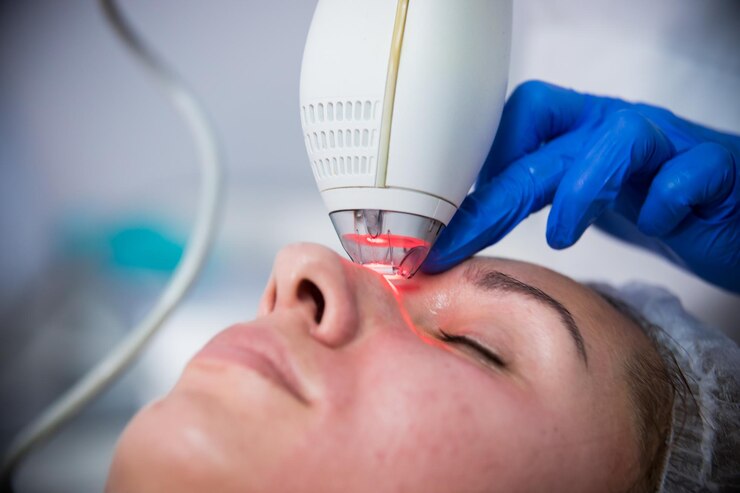
Fractional CO2 Laser is widely used in selected acne scar treatment protocols because it creates controlled microscopic thermal injuries, stimulating the skin’s natural regenerative and remodeling processes.
At Oceania, physicians assess scar type, depth, skin condition and pigmentation risk before developing an individualized treatment plan.
What Is Fractional CO2 Laser?
CO2 Laser uses a wavelength of approximately 10,600 nm, which is strongly absorbed by water in biological tissue.
With fractional technology, the Laser does not treat the entire skin surface uniformly. Instead, it creates microscopic treatment columns distributed across the target area.
Untreated or less-affected areas remain between these microscopic treatment zones.
These surrounding areas can help support the skin’s natural recovery process.
Why Does Fractional CO2 Laser Create Micro-Injuries?
This is one of the fundamental principles behind the treatment.
When appropriate Laser energy is delivered into the skin, it creates controlled microscopic injuries.
The skin recognizes these areas as sites requiring repair and activates natural healing mechanisms.
The process can be broadly understood as:
Controlled micro-injury → healing response → collagen remodeling → tissue restructuring → improved skin texture
The goal is not to “burn away” the entire skin surface, but to create controlled stimulation that encourages regeneration.
How Does Fractional CO2 Laser Stimulate Collagen?
Collagen is one of the key structural proteins responsible for maintaining skin structure and firmness.
When skin is exposed to appropriately controlled Laser energy, biological activity involved in new collagen production can be stimulated.
Over time, collagen remodeling may help:
- Improve skin texture.
- Smooth uneven surfaces.
- Soften the appearance of selected scars.
- Reduce the visible depth of some acne scars.
- Improve overall skin quality.
However, acne scars do not disappear completely after a single Laser session.
The degree of improvement depends on scar type, severity and individual response.
Can Fractional CO2 Laser Treat Every Type of Acne Scar?
No.
This is one of the most important considerations when selecting an acne scar treatment.
Common acne scar types include:
Ice Pick Scars
Narrow and deeper scars extending into the skin.
Boxcar Scars
Depressed scars with relatively defined edges and broader bases.
Rolling Scars
Wavy or undulating depressions, often associated with fibrous bands pulling the skin downward.
Each scar type has a different structural mechanism.
Therefore, Fractional CO2 Laser may be appropriate for certain scars, while other cases may require combination treatment.
Why Do Some Patients Still Have Acne Scars After Laser Treatment?
One reason is that acne scars are not always only a surface-level problem.
Some scars are associated with fibrous bands that pull the skin downward.
If treatment only addresses the surface while deeper structural components remain untreated, improvement may be limited.
Depending on the individual case, a physician may consider combining:
- Fractional CO2 Laser.
- Subcision.
- TCA CROSS.
- RF Microneedling.
- PRP.
- Other regenerative skin treatments.
Not every patient requires all of these approaches.
Is Fractional CO2 Laser Painful?
The sensation during treatment depends on:
- Energy level.
- Treatment area.
- Treatment depth.
- Individual pain tolerance.
A topical anesthetic cream may be applied before treatment to improve comfort.
After treatment, temporary effects may include:
- Redness.
- Warmth.
- Mild swelling.
- Dryness or light peeling.
The degree and duration of recovery vary depending on treatment settings and individual skin response.
How Should You Care for Your Skin After Fractional CO2 Laser?
Post-treatment skincare plays an important role in recovery.
1. Protect Your Skin From the Sun
Skin can be more sensitive to sunlight following Laser treatment.
Sun protection and avoiding excessive direct sun exposure are important to reduce the risk of post-inflammatory hyperpigmentation.
2. Support the Skin Barrier
Your physician may recommend appropriate recovery-focused skincare products.
3. Do Not Pick or Peel the Skin
Manually removing peeling skin may increase irritation and interfere with the healing process.
4. Temporarily Avoid Irritating Actives
Depending on your skin condition, your physician may recommend temporarily stopping certain ingredients such as retinoids or acids.
Is Fractional CO2 Laser Suitable for International Patients in Vietnam?
It can be suitable for selected patients, but individual skin type and pigmentation risk must be assessed.
This is particularly important for Asian skin types and patients with Fitzpatrick III–V skin, who may have a higher risk of Post-Inflammatory Hyperpigmentation (PIH) after certain Laser treatments.
A treatment protocol designed for another patient should therefore not simply be copied for you.
Fractional CO2 Laser Treatment at Oceania
At Oceania, acne scar treatment begins with a direct physician assessment.
The physician may evaluate:
- Scar type.
- Scar depth.
- Treatment area.
- Skin quality.
- Skin sensitivity.
- Fitzpatrick Skin Type.
- History of hyperpigmentation.
- Previous treatments.
- Current acne activity.
Based on the assessment, the physician determines whether Fractional CO2 Laser is appropriate or whether another or combined approach would be more suitable.
Oceania’s USP – What Makes the Clinic Different?
Physician-Led Treatment
Oceania follows a doctor-led treatment model.
Physicians directly assess the patient’s skin and determine the appropriate treatment approach rather than applying the same protocol to everyone.
Personalized Laser Settings
Not every patient requires the same Laser energy or treatment depth.
Settings may be adjusted according to:
- Scar type.
- Skin condition.
- Treatment goals.
- Recovery capacity.
- Pigmentation risk.
Combination Treatment When Appropriate
For selected patients, physicians may combine CO2 Laser with other technologies to address different mechanisms contributing to acne scarring.
Medical-Standard Treatment Process
Oceania emphasizes:
✔️ Direct physician assessment.
✔️ Hygiene and infection-control procedures.
✔️ Professional equipment.
✔️ Personalized treatment protocols.
✔️ Monitoring of skin response.
✔️ Detailed post-treatment skincare guidance.
Traceable Professional Equipment
Oceania emphasizes equipment traceability and identifiable device information. Certain technologies may meet international standards such as FDA or CE, depending on the specific device.
International Patient Support
For international patients, Oceania provides English-language support so patients can clearly understand:
- Their acne scar type.
- The selected technology.
- The treatment process.
- Expected recovery.
- Post-Laser care.
How Many Fractional CO2 Laser Sessions Are Needed?
There is no fixed number for every patient.
The number of sessions depends on:
- Scar type.
- Scar depth.
- Treatment area.
- Age of the scars.
- Individual collagen response.
- Combination treatments.
Some patients may require multiple sessions, with sufficient recovery time between treatments.
The realistic goal is usually progressive improvement in skin texture and overall skin quality, rather than expecting scars to disappear completely.
Conclusion
Fractional CO2 Laser treats acne scars by creating controlled microscopic thermal injuries that stimulate the skin’s healing response, collagen remodeling and tissue restructuring.
However, the technology itself is only one part of successful acne scar treatment.
Accurate scar diagnosis + appropriate technology + personalized settings + proper aftercare are the foundation of a safe and effective treatment plan.
At Oceania, physicians directly assess each patient’s acne scars and develop an individualized treatment strategy.
If you are looking for Acne Scar Treatment Vietnam, Fractional CO2 Laser Vietnam or Acne Scar Treatment in Ho Chi Minh City, a professional consultation is the best first step to determine your scar type and the most appropriate treatment approach.
FAQ
Can Fractional CO2 Laser completely remove acne scars?
Complete removal cannot be guaranteed. The goal is to improve scar depth, texture and overall skin quality. Results vary according to scar type and individual response.
Does Fractional CO2 Laser make the skin thinner?
When performed with appropriate indications and settings, the treatment is designed to stimulate regeneration and remodeling rather than intentionally thin the skin.
How long is the recovery after CO2 Laser?
Recovery varies depending on treatment intensity and individual skin response. Your physician can provide a more specific recovery expectation based on the selected settings.
Can PRP be combined with CO2 Laser?
In selected cases, PRP may be considered as a supportive approach for skin recovery and regeneration. However, combination treatment is not necessary for everyone.
Can foreigners receive acne scar treatment at Oceania?
Yes. Oceania welcomes international patients and provides English-language support throughout consultation, treatment and post-treatment care.