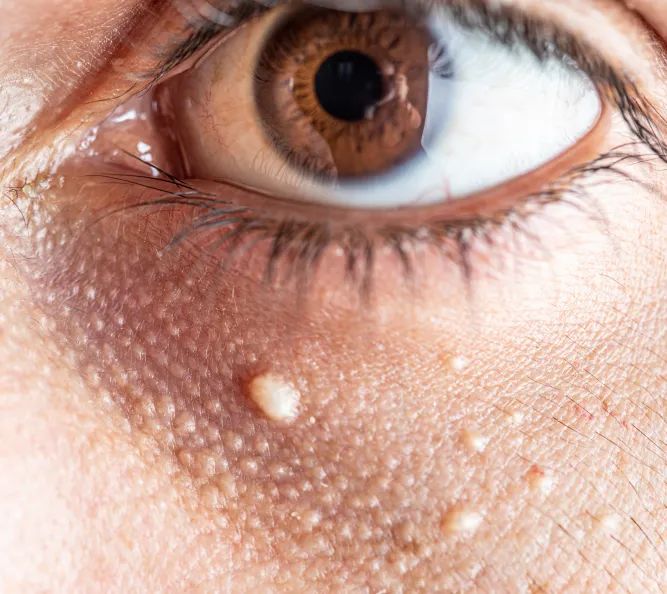
Tiny bumps around the eyes are often grouped together as “skin tags” or “small white bumps,” but they are not necessarily the same condition.
Two commonly confused benign lesions are syringomas, which arise from eccrine sweat ducts, and milia, small keratin-filled cysts that sit closer to the skin surface. Correct diagnosis matters because the depth and treatment strategy are different.
For selected cases, CO2 laser can be used to precisely ablate these lesions. Because periocular skin is extremely thin, however, the goal is not aggressive removal. Treatment should focus on targeting the lesion while minimizing unnecessary thermal injury to the surrounding healthy skin.
Contents
1. Syringoma vs. Milia: What Is the Difference?
Syringoma: a benign sweat-duct tumor
A syringoma is a benign adnexal tumor associated with eccrine sweat ducts. It commonly appears as multiple small, skin-coloured or slightly yellow papules, particularly around the lower eyelids.
Typical features include:
- Small bumps close to the natural skin tone.
- Multiple similar-looking lesions.
- Often symmetrical involvement around both eyes.
- No “core” that can simply be squeezed out like acne.
Because syringomas may extend deeper into the dermis, overly superficial treatment may leave residual tissue and allow the lesions to recur. Treatment that is too aggressive, on the other hand, can increase the risk of pigmentary change or scarring.
Milia: tiny keratin-filled cysts
Many bumps commonly described as “sebaceous deposits” are actually milia.
Milia are small cysts filled with keratin rather than sebum. They usually appear as pearly-white bumps beneath the surface of the skin and are particularly common around the eyelids and cheeks.
Compared with syringomas, milia tend to be:
- Whiter or more pearly in colour.
- More superficial.
- More cyst-like in appearance.
- Suitable for sterile de-roofing and extraction in many isolated cases.
For extensive or persistent milia, techniques including electrosurgery, curettage and laser ablation may also be considered.
This is why every cluster of small periocular bumps should not automatically receive the same treatment.
2. How Does Fractional CO2 Laser Treat Periocular Syringomas?
CO2 lasers operate at a wavelength of 10,600 nm, which is strongly absorbed by water in tissue. This allows controlled vaporization of targeted tissue together with a precisely managed thermal effect.
CO2 laser is one of the most widely used laser options for syringoma treatment. Techniques such as pinhole and multiple-drilling methods deliver energy directly into individual lesions rather than aggressively resurfacing the entire area. Reviews suggest that these approaches can provide good cosmetic improvement with relatively limited adverse effects, while fractional techniques may reduce downtime and complications compared with traditional full-field ablation.
For delicate under-eye skin, the treatment principle is:
Correct diagnosis → correct depth → controlled energy → precise treatment spot.
The objective is to ablate the lesion in a controlled manner while preserving as much surrounding healthy skin as possible.
Temporary redness, small crusts and sensitivity may occur during recovery. Patients should avoid picking the area and follow appropriate post-laser skincare and sun protection to reduce the risk of post-inflammatory pigmentation.
It is also important to avoid absolute claims such as “zero risk of scarring.” CO2 laser can cause prolonged redness, pigmentation changes and, less commonly, scarring when treatment is overly aggressive or healing is complicated. Periocular laser procedures also require appropriate eye protection and careful knowledge of eyelid anatomy.
Syringomas may also recur because the lesions can extend into the deeper dermis. A realistic treatment goal is therefore visible reduction with a good cosmetic result and minimal scarring, rather than guaranteeing permanent removal.
3. Why Choose Oceania for Periocular CO2 Laser Treatment?
At Oceania Spa & Clinic, the treatment approach is not simply “laser removal.” It begins with identifying the lesion correctly and controlling the treatment area before ablation.
Diagnosis Before Treatment
The physician evaluates the colour, size, distribution and depth of the bumps to determine whether they are more consistent with syringomas, milia or another benign skin lesion.
This matters because a superficial milium should not automatically be treated in the same way as a deeper syringoma.
Bluxel 10,600 nm Fractional CO2 Laser
According to Oceania’s device documentation, Bluxel is a fractional CO2 laser system operating at 10,600 nm and is designed for dermatologic ablation, including the removal of selected benign skin lesions such as syringomas.
The system supports different beam patterns and adjustable treatment areas from approximately 2 to 20 mm, allowing the treatment field to be adapted to small, localized lesions.
This degree of control is particularly relevant around the eyes, where the skin is thin and precision is essential.
Controlled Energy Rather Than Aggressive Ablation
Oceania does not approach periocular lesions with a “higher energy is better” strategy.
Treatment planning may take into account:
- Type of lesion.
- Size and estimated depth.
- Number of lesions.
- Skin type and tone.
- History of pigmentation or scarring.
- Proximity to the eyelid margin and other sensitive structures.
The aim is to achieve an appropriate clinical effect while limiting unnecessary injury to surrounding tissue.
Structured Post-Laser Follow-Up
After treatment, patients receive guidance on gentle cleansing, skin recovery and sun protection, with clear instructions not to pick or prematurely remove crusts.
Follow-up is particularly important around the eyes, both to monitor healing and to determine whether any residual lesions require further treatment.
Conclusion
Not every small bump around the eyes is the same. Syringomas are benign sweat-duct tumors, whereas milia are superficial keratin-filled cysts, and the distinction directly affects treatment planning.
Fractional CO2 laser can be an effective option for selected syringomas and some extensive milia, but periocular treatment requires careful control of lesion depth, energy and treatment area.
Contact Oceania Spa & Clinic for a physician-led assessment of periocular bumps and a personalized CO2 laser treatment plan before proceeding with removal.