


Contents
- 1
- 2 What Is HIFU Facial Lifting?
- 3 How Does HIFU Work?
- 4 Does HIFU Require Surgery?
- 5 Which Areas Can HIFU Treat?
- 6 Can HIFU Thin the Skin or Reduce Collagen?
- 7 Does HIFU Remove Facial Fat?
- 8 Is HIFU Painful?
- 9 When Will HIFU Results Become Visible?
- 10 Can HIFU Replace a Surgical Facelift?
- 11 What Makes HIFU Treatment at Oceania Different?
- 12 Is HIFU Suitable for Expats Living in Vietnam?
- 13 Conclusion
- 14 FAQ
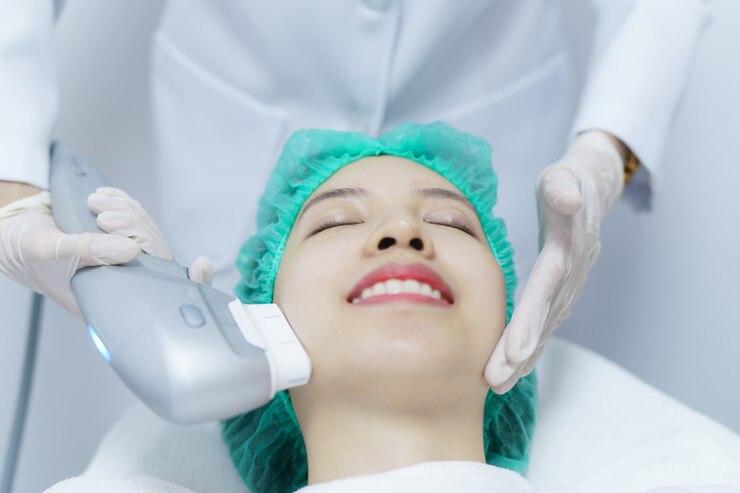
What Is HIFU Facial Lifting?
As the face ages, it does not simply develop wrinkles. Skin gradually loses firmness, the cheeks may begin to sag, the jawline becomes less defined and the area under the chin may appear heavier.
This is why HIFU Face Lifting has become an increasingly popular option for people who want to improve mild to moderate skin laxity without undergoing surgery.
HIFU stands for High-Intensity Focused Ultrasound.
Instead of cutting or surgically lifting the skin, HIFU uses focused ultrasound energy to create controlled thermal effects at selected tissue depths.
The treatment aims to support:
- Collagen remodeling.
- Improved skin firmness.
- Support of soft-tissue tightening.
- Better jawline definition.
- Improvement of the appearance of the submental area in suitable patients.
- Natural-looking facial rejuvenation without surgery.
How Does HIFU Work?
The key feature of HIFU is its ability to concentrate ultrasound energy at selected tissue depths rather than treating the entire skin surface uniformly.
The focused energy creates controlled thermal stimulation at the targeted tissue.
The body then initiates its natural repair and remodeling response, including collagen remodeling.
Over time, this process may contribute to improved skin firmness and overall tissue quality.
This also means that HIFU results are generally not comparable to the immediate structural changes created by facelift surgery.
Results typically develop gradually as collagen remodeling takes place.
Does HIFU Require Surgery?
No.
One of the major advantages of HIFU is that it is a non-surgical treatment that does not require skin incisions.
During a typical HIFU treatment:
- There is no skin cutting.
- No sutures are required.
- There is no surgical tissue dissection.
- Recovery is generally shorter than after surgical facelift procedures.
This makes HIFU particularly appealing to busy professionals and international patients living and working in Vietnam.
However, “non-surgical” does not mean that HIFU is suitable for everyone.
The degree of laxity, soft-tissue volume, facial anatomy and skin condition should be evaluated before treatment.
Which Areas Can HIFU Treat?
Depending on the patient’s facial structure and treatment goals, physicians may consider areas such as:
Cheeks
To support improvement in mild skin laxity and cheek contour.
Jawline
HIFU may help improve the appearance of a less-defined jawline in suitable patients.
Under the Chin
In selected cases, HIFU may be used to support improvement of the appearance of soft tissue in the submental area.
Neck
HIFU may also be considered when the neck has reduced skin firmness.
However, different areas do not necessarily require the same energy level or number of treatment lines.
This is why personalized facial mapping is important.
Can HIFU Thin the Skin or Reduce Collagen?
This is a common concern among patients considering HIFU.
HIFU is designed to deliver controlled thermal stimulation to selected tissue with the goal of supporting tissue remodeling.
However, excessive energy or inappropriate treatment areas may produce unwanted effects.
For this reason, HIFU should not be performed using exactly the same settings for every patient.
A physician should consider:
- Soft-tissue thickness.
- Degree of skin laxity.
- Facial anatomy.
- Treatment location.
- Treatment depth.
- Energy level.
- Aesthetic goals.
For patients who naturally have low facial soft-tissue volume, assessing tissue distribution before treatment is particularly important to avoid an overly hollow or excessively lean facial appearance.
Does HIFU Remove Facial Fat?
This distinction is important.
The goal of HIFU facial lifting is not necessarily fat reduction.
Certain treatment settings and depths may be used as part of strategies targeting localized soft tissue or fat. However, treatment areas and parameters should be selected according to the patient’s anatomy and goals.
If a patient already has a naturally slim face or limited facial fat, the physician should be particularly careful when selecting treatment areas.
At Oceania, the goal is not simply to make the face “as slim as possible”, but to improve firmness and facial definition while maintaining appropriate facial balance.
Is HIFU Painful?
The treatment experience can vary depending on:
- Treatment area.
- Individual pain tolerance.
- Energy level.
- Treatment depth.
- Soft-tissue structure.
Some patients may experience:
- Mild tingling.
- Warmth or pressure.
- Temporary sensitivity or tenderness.
The sensation is not necessarily identical for every patient.
Treatment parameters should be adjusted to balance clinical objectives and patient comfort.
When Will HIFU Results Become Visible?
Some patients may notice early changes in firmness or facial definition.
However, more noticeable results generally require time for collagen remodeling to occur.
The appearance of the skin may continue to evolve over the following weeks or months depending on individual response and treatment protocol.
Therefore, HIFU may be particularly suitable for people who prefer:
Gradual, natural-looking rejuvenation rather than a dramatic overnight change.
Can HIFU Replace a Surgical Facelift?
HIFU and facelift surgery should not be considered equivalent treatments.
Surgery can remove excess skin and reposition significantly lax tissue in ways that non-surgical treatments cannot fully replicate.
HIFU may be more suitable for patients who:
- Have mild to moderate skin laxity.
- Want to improve firmness.
- Prefer a non-surgical approach.
- Want to minimize downtime.
- Prefer subtle, natural-looking results.
For significant skin laxity, a physician may recommend other treatment options.
What Makes HIFU Treatment at Oceania Different?
At Oceania, HIFU is not performed using a one-size-fits-all protocol.
Direct Physician Assessment
Before treatment, the physician evaluates:
- Skin laxity.
- Soft-tissue volume.
- Facial structure.
- Jawline definition.
- Submental area.
- Signs of aging.
- Previous aesthetic procedures.
This helps determine whether HIFU is actually appropriate.
Personalized Treatment Areas and Energy
One of the most important aspects of HIFU is treating the correct depth and the correct anatomical area.
The entire face does not necessarily require the same energy level.
A physician may create an individualized treatment map based on the patient’s anatomy and aesthetic goals, minimizing unnecessary treatment of areas that already have limited soft-tissue volume.
Professional Equipment and Treatment Process
Oceania prioritizes equipment with identifiable origins, with device information and serial numbers managed according to the clinic’s procedures.
Depending on the specific device, certain technologies may meet international standards such as FDA or CE.
Medical-Standard Treatment Process
The process generally follows:
Assessment → Evaluation → Personalized Plan → Treatment → Monitoring → Aftercare
This is particularly valuable for international patients who want to clearly understand which technology is being used and why.
Is HIFU Suitable for Expats Living in Vietnam?
HIFU can be an option for international residents in Vietnam who want to address mild facial laxity without undergoing surgery.
It may be particularly attractive to people who:
- Have demanding work schedules.
- Prefer minimal downtime.
- Want to maintain a natural appearance.
- Want to improve jawline definition.
- Are searching for Non-Surgical Face Lifting in Vietnam.
Oceania provides English-language support throughout consultation and aftercare for international patients.
Conclusion
HIFU Face Lifting uses focused ultrasound energy to create controlled thermal stimulation at selected tissue depths, supporting collagen remodeling and skin tightening without surgery.
However, the outcome depends significantly on:
- Patient selection.
- Treatment depth.
- Energy level.
- Treatment area.
- Facial anatomy.
- Skin condition.
At Oceania, physicians directly assess each patient and create a personalized treatment plan designed to support balanced, natural-looking facial definition rather than simply making the face look “slimmer.”
If you are searching for HIFU Vietnam, HIFU Face Lifting Vietnam or Non-Surgical Face Lifting for Expats, a professional assessment is the best starting point to determine whether HIFU is appropriate for your facial structure and goals.
FAQ
Is HIFU facial lifting a surgical procedure?
No. HIFU is a non-surgical treatment and does not require incisions or sutures like a surgical facelift.
Does HIFU provide immediate results?
Some early changes may be noticeable, but the lifting and tightening effect generally develops progressively as collagen remodeling occurs.
Can HIFU make the face look hollow?
HIFU is not simply a facial fat-removal procedure. However, inappropriate treatment areas or settings may lead to undesirable results. Assessing facial soft-tissue volume before treatment is therefore important.
Can HIFU replace a facelift?
Not completely. HIFU is generally more appropriate for mild to moderate laxity and patients who prefer a non-surgical approach. Significant skin laxity may require other treatment options.
Is there downtime after HIFU?
Downtime is generally considerably shorter than with surgery, although individual reactions can vary.
Can international patients receive HIFU at Oceania?
Yes. Oceania provides English-language support for international patients and develops treatment plans according to individual skin condition, facial anatomy and aesthetic goals.